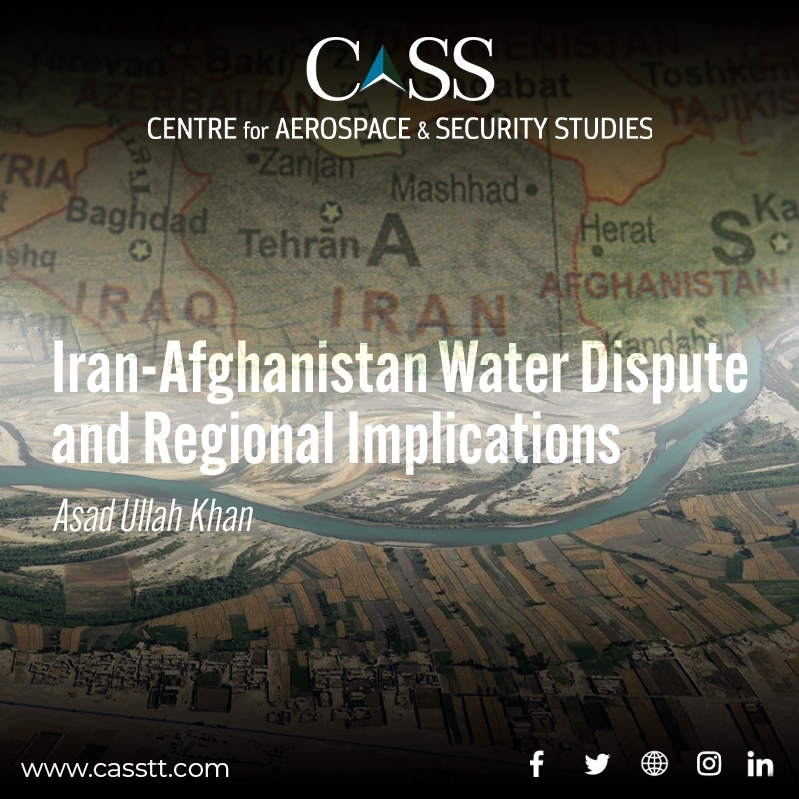
The water issue between Iran and Afghanistan is not new. It can be traced back to 1973 when a formal treaty was signed between the two countries. Despite this agreement, both states have been unable to amicably resolve their transboundary water issues.
Friction escalated in 2021 with the completion of the Kamal Khan Dam in Afghanistan, inaugurated by then-President Ashraf Ghani. Iran, being concerned about the construction on the Helmand River, raised specific objections. With the construction of this dam, Afghanistan failed to fulfill its obligation of sharing 850 million cubic meters of water annually with Iran, as outlined in the 1973 treaty. Iran alleges that it has only received approximately 4% of the agreed share of water.
Against this backdrop, the recent border clashes between Iran and Afghanistan has increased the political temperature of the region. In the latest clash, on 27th May, two Iranian border guards, and one Taliban fighter tragically lost their lives. In response to this incident, Iran took the step of closing the Malik Zarnaj Border crossing, a vital commercial passage connecting the two nations.
In this context, the responsibility for the escalated tensions lies with the Taliban. At a time when regional countries are striving for stability in the region, disputes with neighboring nations raise legitimate concerns regarding the intentions and modus operandi of the current Afghan government.
Iran’s vulnerability to water scarcity has increased over the past few decades. Recent satellite images shared by IRNA reveal a significant reduction in water flow towards Iran due to the operational Kamal Khan Dam, which Tehran argues is a violation of the 1973 agreement. It is important to note that according to international law, specifically the Madrid Declaration of 1911, altering or modifying rivers and lakes to the detriment of a co-riparian state requires the consent of both parties. In light of customary international law, it is crucial for both Iran and Afghanistan to respect each other’s water rights and avoid engaging in a dispute that could further complicate the situation.
In a similar vein, Pakistan is also trying to seek a formal agreement on the Kabul River water sharing mechanism with Afghanistan. However, no positive development has taken place so far. Afghanistan has already built five strategic dams on Kabul River in the past few decades namely – Chak, Mahipar, Sarawbi, Naghalao and Dronaq dams. Pakistan has expressed interest in addressing the upper and lower riparian rights of both nations through bilateral agreements and talks. However, despite many attempts, the current and former leadership in Afghanistan has shown no interest in initiating any formal mechanisms for resolving this issue.
Such disputes are not only concern for Pakistan but could also have a negative impact on Pakistan-China efforts to promote stability in the region. The recent trilateral meeting of Foreign Ministers of Pakistan, Afghanistan, and China shows an evolved foreign policy aspiration of Beijing towards its neighbours. According to its official stance, China respects independence, sovereignty and territorial integrity of Afghanistan. Its Global Security Initiative (GSI) and Global Development Initiative (GDI) also indicate that it considers Kabul an opportunity for cooperation, rather than a battleground of geopolitics.
During a critical period when the Afghan Taliban is actively seeking international recognition, China and Pakistan have stepped forward to provide support in terms of peace and reconstruction efforts, as well as considering extending the benefits of the China-Pakistan Economic Corridor (CPEC) to this region. However, any further Iran-Afghanistan border skirmishes could potentially raise concerns for all stakeholders involved. More importantly, if such a situation escalates China may no longer wish to invest in a country whose actions are detrimental to water security of neighboring states.
In conclusion, for Afghanistan to achieve stability and prosperity, it is crucial for the Taliban government to prioritise not only gaining legitimate recognition but also fostering regional cooperation and resolving conflicts. Given Afghanistan’s history of being a war-torn nation and Iran’s status under sanctions, it is in the best interest of both countries to avoid disputes that hinder their shared goals of attaining comprehensive national security and international cooperation. Instead of engaging in confrontational politics, they should explore opportunities for bilateral cooperation and address water-related issues in accordance with international law. By doing so, they can work towards mutually beneficial solutions and pave the way for a more harmonious and productive relationship and region.
Asad Ullah Khan is a Senior Research Associate at the Centre for Aerospace & Security Studies (CASS) Islamabad, Pakistan. The article was first published in Modern Diplomacy. He can be reached at [email protected]