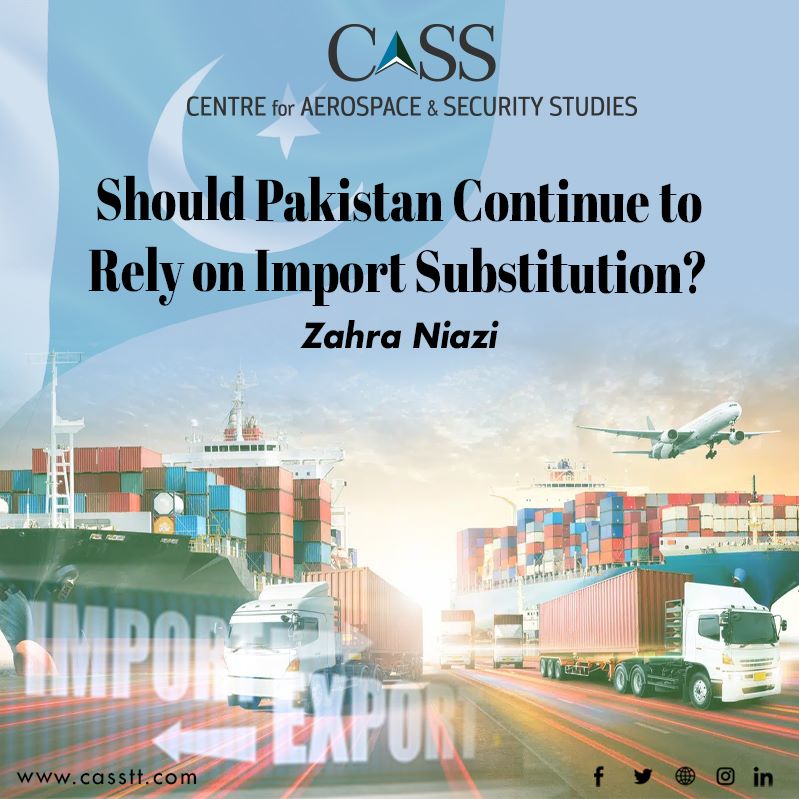
In the wake of Pakistan’s present economic turmoil, some voices supported pursuing the strategy of Import Substitution Industrialisation (ISI). The most notable development in this regard was when the National Security Committee (NSC) in January suggested that import substitution should be prioritised for strengthening the economy. This strategy is based on the rationale that substituting domestically produced goods for imported manufactured items would increase the pace of industrialisation and is achieved through policy instruments such as import quotas, tariff protection, or appreciation of the national currency.
In fact, Pakistan’s trade and industrial policies have long reflected a bias towards import substitution activities. According to the International Monetary Fund (IMF), import duties and related taxes account for about half of the total tax revenue in the country, and import tariffs remain higher than most Emerging Markets and Developing Economies (EMDEs). Estimates suggest that while import tariffs have decreased in the rest of the world during the last decade, they have increased by 11 percent in Pakistan. Additionally, many sectors in the economy remain protected from foreign competition due to the existence of many state-owned enterprises (SOEs), distortive policies protecting special interest groups, and weak implementation of competition rules. The Overall Trade Restrictiveness Index (OTRI) ranks Pakistan as the seventh most protected economy in the world. Protectionist policies have promoted an anti-export bias, preventing the development of viable import-competing and export-oriented industries.
The apparent appeal of ISI notwithstanding, economic literature suggests it is unlikely to promote sustainable economic growth. Several developing countries, such as Pakistan, Nigeria, India, Brazil, Argentina, Mexico, Chile, and Mozambique, embarked on the path of ISI in the 1950s. The strategy initially promoted growth in these countries but a decade later began to generate economic imbalances, including budget and current account deficits. The governments in these countries heavily invested in SOEs and used state budgets to keep these industries afloat, many of which never became profitable, leading to persistent budget deficits.
Second, ironically, import substitution increased the demand for imported machines and parts required for domestic manufacturing. Simultaneously, it reduced countries’ capacity to export. Domestic producers could not become efficient and competitive in the international markets. They were unable to realise economies of scale due to the small size of the domestic markets. Economies of scale arise when the cost of production falls with the increase in the number of units produced. Additionally, most governments in these countries maintained overvalued exchange rates, making domestic goods overpriced in foreign markets and foreign goods cheaper in the home markets. This price difference created the incentive to import inputs and made it challenging for domestic producers to export. At the same time, governmental policies to promote industrialisation weakened the rate of agricultural growth and production. The combined effect of these factors generated current account deficits in the countries pursuing ISI.
This strategy also paved the way for corrupt practices, such as rent-seeking. For example, private actors could easily exploit the political system to attain a higher-than-market return on economic activity. Many of these governments had to engage in foreign borrowing to sustain ISI, which only provided temporary relief. The end product was a period of crisis and reform in the 1980s.
This highlights that while import substitution may give positive returns in the short run, sooner or later, it generates an unbalanced economic structure and stimulates foreign dependency. Policymakers in Pakistan must realise that the country needs to turn away from this inward-oriented strategy rather than move further in this direction. Even after 76 years of independence, export growth remains a major challenge for the country, and its export product mix still needs to grow. According to the World Bank, Pakistan’s exports stand at 9.06% of GDP against a global average of 42.1%. Similarly, Pakistan has been a dependent economy and has turned to the IMF twenty-three times, suggesting the need for far-reaching reforms.
It is high time that the policymakers in Pakistan earnestly and meaningfully re-evaluate the strategy based on policy instruments reflective of import substitution. Any re-evaluation should not be temporary or based on external conditionality but should become an integral part of broad structural reforms to increase the economy’s efficiency. Some forms of protectionist policies may still have to exist or be selectively implemented based on circumstances; continued and excessive reliance is, however, detrimental to Pakistan’s long-term interests of promoting industrialiaation and export growth and achieving self-sufficiency.
Zahra Niazi is a Research Assistant at the Centre for Aerospace & Security Studies (CASS), Islamabad, Pakistan. She can be reached at [email protected].