After the Russian invasion of Ukraine in February 2022, there was a systemic push by the Western powers to retaliate against Russia in the economic domain. Although it was recognized that such economic warfare would generate acute turbulence in the world economy, it was decided that the economic disruption would be offset by either the moral calling of standing with Ukraine or imposing punitive and crippling sanctions that would incur crippling costs for Russia’s aggression. A part of this economic warfare was prosecuted at the governmental level, such as through explicit sanctions regimes or the SWIFT-system exclusion. However, part of this was to be executed by corporations that engaged in commerce and investment in Russia. It was expected that these Western corporations would forgo their operational and financial interests in Russia for the larger moral cause of support to Ukraine during its time of unprecedented ordeal.
But did Western companies really follow through with this moral commitment to the cause? If one were to gauge from their virtue-signaling public messages, it would appear that Western corporations were not just standing in solidarity with Ukraine but actually at the vanguard of combat themselves. A study by Evenett and Pisani demonstrates that less than 10% of European firms have divested themselves from Russia. Instead of towing the line of their governments, these corporations continue to happily do business, even as they virtue-signal their solidarity to the public and to shareholders.
In their study, Evenett and Pisani identified 2,405 subsidiaries owned by 1,404 multinationals at the start of the conflict, out of which more than 90% have remained well after the prosecution of the war began. What is interesting is that, out of the many remaining firms, 20% are German, whose role in EU affairs is significant and whose supranational position has been singularly condemnatory towards Moscow’s belligerence. Among those few that did divest, many had less than 10% of their operating profit derived from Russia and roughly 15% of their employee base. Therefore, their decision may have been influenced as much by lower profit-to-employee ratios as by moral grandstanding.
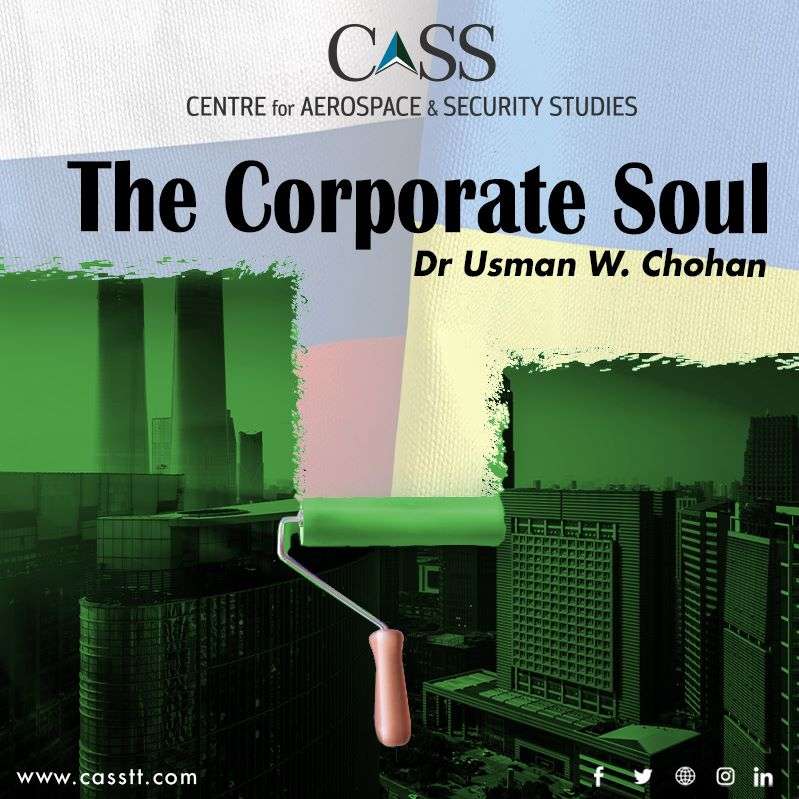
This echoes a pattern observed among corporations of “greenwashing” their operations, which is to say, using a genteel rhetoric for shareholders and the public. They enshroud their operations in the garb of “eco-friendly”, “diversity”, “progressive,” and other soft-sounding soundbites, even as their actual activities may work as cross-purposes to the publicly desired objectives. This was strongly observed in the COP summits, at Davos, and Black Lives Matter, where corporations positioned themselves to extract further consumer spending by hijacking these social movements. Much critique of corporate double-standards has come forth as consumers are seeing through this charade, particularly through activism on social media highlighting the mismatch between the corporate appearance and the corporate soul.
The fact that such little European corporate decision-making has been changed by the Russo-Ukrainian war also points to the larger question of geopolitics vs. geoeconomics. Although many have heralded the demise of globalization and the the new “national security” mindset that has won over against corporate or economic interest, perhaps this claim has been somewhat exaggerated. Geoconomics has given way to geopolitics in several major international tussles (West vs. China, West vs. Russia), but not to the extent that pundits appear to claim. If 90% of Western multinationals are remaining and doing business in Russia well after an international conflict broke out, and 20% of those companies are German, perhaps the tension between geopolitics and geoeconomics is not as stark as one might think. At the same time, what was true before this conflict and remains true today is that corporations are more than happy to talk in a manner that consumers like to hear, but not act in a manner that consumers would like them to act.
Dr. Usman W. Chohan is Advisor (Economic Affairs and National Development) at the Centre for Aerospace & Security Studies, Islamabad. He can be reached at [email protected].