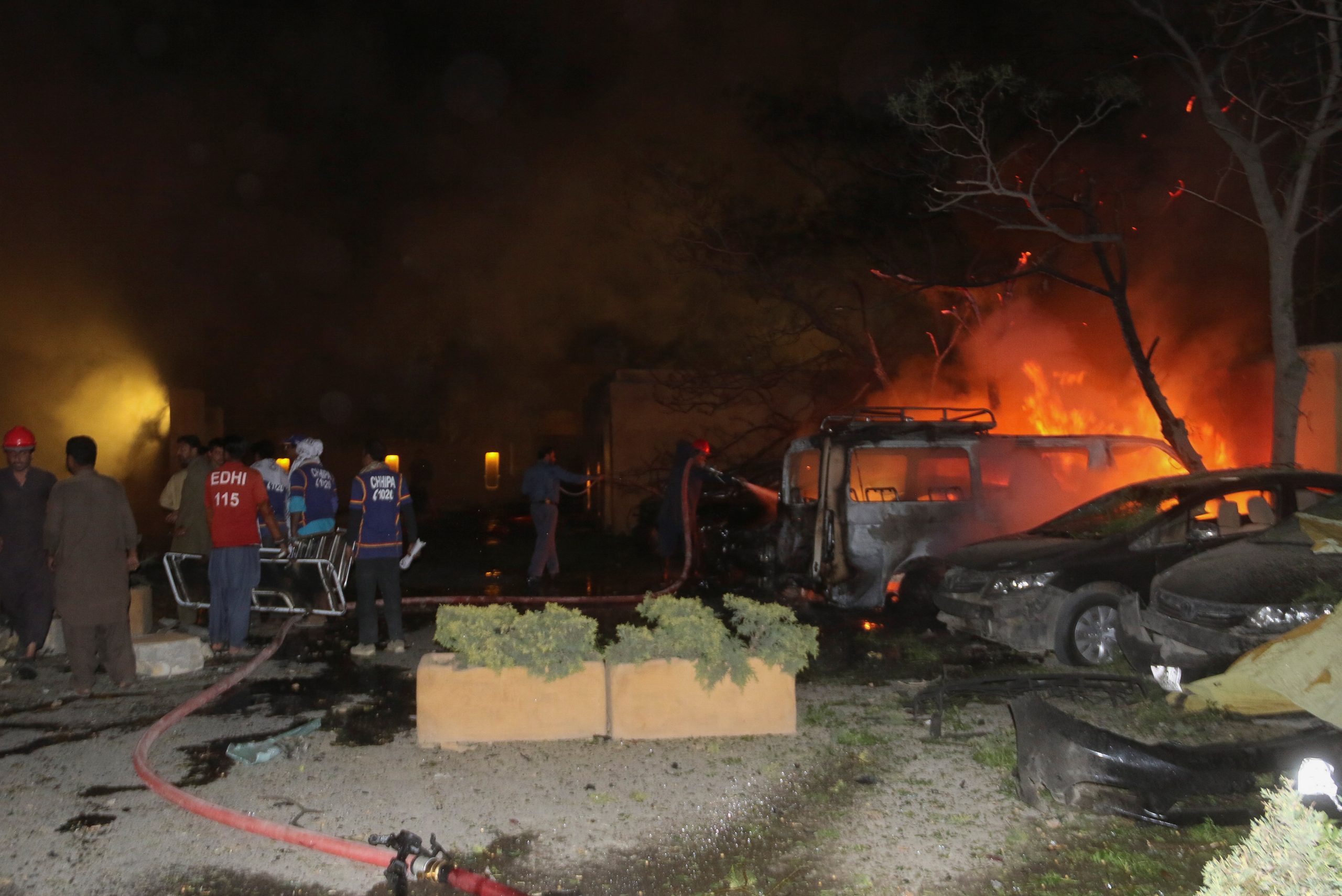
Pakistan witnessed a very significant decline in acts of terrorism over the past few years. Reduction in terrorism-related violence was mainly attributable to decisions by the political leadership, public support and efforts as well as sacrifices made by the Armed Forces and Law Enforcement Agencies (LEAs). However, the suicide attack in the parking of Serena Hotel in Quetta on April 21, claimed by Tehreek e Taliban Pakistan (TTP), reminds us that though the threat of terrorism has reduced, it has not been totally eradicated from the country. This unfortunate incident points towards complacency, failure of multiple departments, and therefore, requires an analysis of the real motive of the attack and identifying weaknesses to avoid such recurrences in future.
The Chinese Ambassador to Pakistan, along with other members of the Embassy, was present in Quetta, although they were not in the hotel at the time of the incident. A 40-50 kg explosive, carried in a car in the parking area, suggests that it was not aimed at the guests staying in the hotel, as high-profile guests don’t normally frequent this area. Additionally, blowing up a car bomb in the parking did not require a suicide attacker, as it could have been detonated remotely, at a time of choosing. This suggests that, either the explosives were to be carried inside the hotel but blew up accidently, or were aimed at inciting fear and panic. The former appears more logical.
Collection, preparation and transportation of such a huge amount of explosives also suggests weaknesses in the intelligence system, especially in a volatile area. All intelligence agencies, thus, need to look at their process of intelligence collection, collation, coordination and information sharing about terrorist threats. Transportation of such a massive amount through parking lot scanners also points toward weakness in the hotel security checking system, incompetence, complacency, poor supervision or connivance, especially when high-profile guests were staying at the hotel.
Police, all across Pakistan, are overstretched with secondary responsibilities. A large number is deployed for escorting and security of ministers, parliamentarians, bureaucracy and senior police officials. This leaves a very small number to look after law and order and other basic responsibilities. The small number of policemen thus end up doing long duty hours, which makes them sedentary, making them ineffective in discharging their duties.
While it may be difficult to find the exact motivation, the place and timing of the recent terrorist attack suggests that it was aimed to delay or slow down the China-Pakistan Economic Corridor (CPEC) by trying to intimidate Chinese nationals working in Pakistan. Many past terrorist acts against Chinese engineers working in the country as well as the 2018 terrorist attack on the Chinese Consulate in Karachi support this argument. This hypothesis suggests that the perpetrators or their masters include those who are opposed to CPEC, the most significant being Pakistan’s Eastern neighbour, who enjoys close links with the Balochistan Liberation Army (BLA) and TTP. However, involvement of other interest groups opposed to Pak-China cooperation or CPEC cannot be ruled out.
Opposition to CPEC and attempts to weaken Pakistan are not likely to end, rather they may increase after the United States’ troop withdrawal from Afghanistan, leaving the country in a lawless state. Therefore, there is a need to assess the threats, identify the opponents and their inside collaborators to work out a strategy to effectively counter such threats. This necessitates improving our intelligence gathering, collation and timely dissemination of information. This cannot be achieved without seamless interagency coordination, clearly defined roles and responsibilities. There is also a need to free the police and other LEAs from protocol/escort duties to increase the number for accomplishment of primary tasks of their respective departments.
Since cyberspace is extensively used for recruitment, coordination and information sharing by terrorist groups and their handlers, mechanisms must be set up to gather information from social media and other internet-dependent systems.
Countries and groups hostile to Pakistan will continue to do what suits them. In our own national interest, we need to be proactive and formulate strategies to counter enemy designs. The National Counter Terrorism Authority (NACTA) must take the lead and review the 2014 National Action Plan (NAP) for its efficacy in the prevalent environment. Revision must be done in consultation with all stakeholders to make a comprehensive plan, owned by all for its successful implementation. The plan must undergo periodic reviews to ensure its usefulness with the evolving environment and conditions. Already available resources such as safe city cameras must be made serviceable and optimally utilised. All LEAs must be provided sufficient, well-trained human resources as well as other necessities to effectively discharge their responsibilities. This would require recalling people deployed on VIP protection. To support LEAs, the public must also contribute by staying more vigilant in their respective area. Any suspect activity or persons should also be reported to the LEAs. It must be remembered that like in the past, there is a need for unified action to defeat this menace.
Air Marshal Ashfaque Arain is Director Strategic Stability and Defence at Centre for Aerospace and Security Studies (CASS). The article was first published in The Nation. He can be reached at [email protected]
Image Source: Reuters