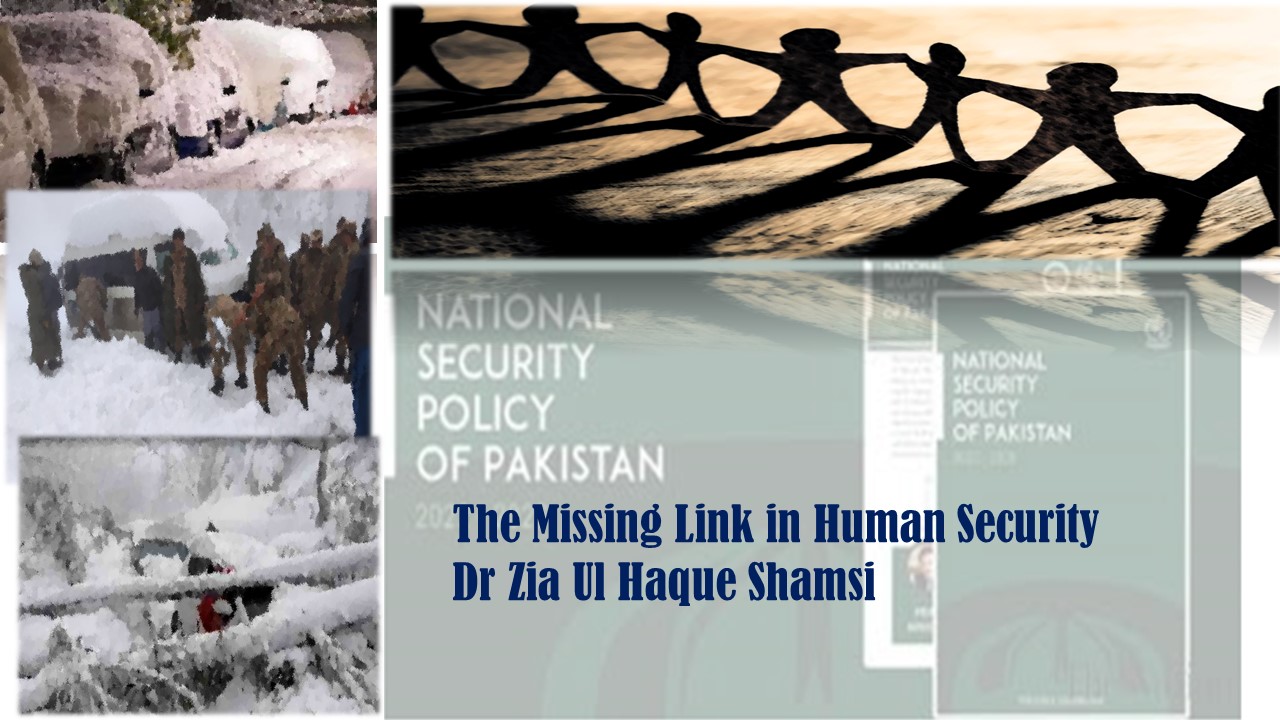
Human security figured out prominently in the recently approved draft of Pakistan’s first-ever National Security Policy (NSP), and it is a welcome step by the government. However, it is extremely important that we understand all aspects of human security and not only those which were presented by Dr Mahbubul Haq’s UNDP Report of 1994. Dr Haq’s report highlighted some seven aspects without which human security would remain a far cry. These included: personal, political, community, environmental, health, economic, and food security. However, with the evolution of information technology, related dimensions like digital and cyber security are also now considered essential for human security.
If the above-mentioned aspects are enough to define human security which is considered essential for the national security of a sovereign state, where do I place the tragic deaths of the stranded tourists on the Murree Hills?
As the narrative goes, thousands of tourists headed to Murree Hills and adjoining areas to spend their holidays and enjoy the snowfall which usually falls on the mountains as well as in the valleys during this time of the year. Reportedly, the visitors kept pouring in and the number of vehicles crossed over 100,000 which was much beyond the road and residential capacity of the area. Resultantly, by 8 January 2022, the traffic jams started to occur and panic started to set in. The local administration did not read the evolving situation until the stranded people started to rant on social media and the reports of tragic deaths of over 20 tourists reached the corridors of power. Most of the deaths occurred due to inhalation of carbon monoxide while stuck in their vehicles during traffic jams due to heavy snowfall en route to their destinations for leisure and fun.
I understand that tragic incidents may happen anywhere and anytime due to unforeseen natural calamities like earthquakes, landslides due to flash floods, heavy rains, and dense fog, but in this particular case, nothing unexpected happened on the day of the occurrence. The downtown Murree does not have the capacity to house more than 5,000 vehicles at any given time, and it was the responsibility of the local administration to manage the traffic. The forecast of a week-long spell of rains and snowfall on the mountains was already there. Their intensity may have increased a little more than expected but that does not absolve the authorities of the responsibility of managing the traffic flow. While the traffic jams had started to occur, the roads leading to Murree Hills should have been strictly closed and emergency evacuation should have started at once. However, nobody moved until the reports of deaths started to appear on social media.
While the stranded tourists were trying to save their lives by moving into safer places like hotels and resorts, the local businessmen thought it appropriate to squeeze them by suddenly raising the hotel room rents and the prices of essential food items. The tourists who had survived the deadly carbon monoxide were suffocated by the cruelty of the local businesses who were out to rob them with whatever was left in their pockets.
This brings me back to the title of this article: The Missing Link of Human Security. While the state is formulating a citizen-centric NSP, where do I place this kind of safety and security lapse on part of the administration, local businessmen, and the tourists?
There is no doubt that this government has made a tremendous effort in promoting tourism in Pakistan after it had virtually disappeared due to internal security concerns over the past decade in general and pandemic fears in the last two years in particular. The government was able to create an enabling environment to bring back domestic and international tourists to famous destinations like Murree, Swat, and Northern Areas in big numbers. However, the missing link is the contingency procedures and development of facilitative culture. For instance, who was responsible for ensuring that the stranded tourists are not robbed by the local businesses? Who was responsible to block the entry points when the traffic jams have started to occur? Who was supposed to do what? Should National Disaster Management Authority (NDMA) be called in this situation? Does the local administration have the capacity to deal with such situations? Should Army be called to meet every unseen situation or we will be able to build the capacity of civil administration?
I suggest that a high-level inquiry commission should investigate the causes of deaths and indicate who is/was responsible for what clearly with recommendations of punitive actions against the defaulters. Only then the people would have confidence in the state’s intent and efforts towards the fulfillment of the dream of ensuring human security essentially required for comprehensive national security.
Dr. Zia Ul Haque Shamsi is Director Peace and Conflict Studies at the Centre for Aerospace & Security Studies (CASS), Islamabad, Pakistan. The article was first published in Daily Times. He can be reached at [email protected].
Image Source: Etfa Khurshid Mirza