Since its independence, India has followed a path in which democracy was merely a slogan rather than the strength of the society. The journey of Indian society from Sangh Parivaar to a character like Yogi Adityanath shows the rapid trend of decay of democracy in India. This gradual decay worsened when the current Bharatiya Janata Party (BJP) government infused the concept of Hindu nationalism into Indian polity and is now building a ‘Hindu Rashtra’.
Since 2019 under BJP’s second term and its extremist polices democracy has further eroded. Narendra Modi used the weapon of parliamentary majority to implement controversial amendments in the Indian Constitution like abrogation of Articles 370 and 35A and the discriminatory Citizenship (Amendment) Act of 2019 which made many citizens alien in their very own country. The main target in both cases were Muslims.
The Modi government also amended the 1967 Unlawful Activities (Prevention) Act and used it for political revenge across the country. The law authorizes that any citizen can be labelled a terrorist without producing any evidence. The clause of denial of bail has forced individuals to spend months and years in prison without even being found guilty.
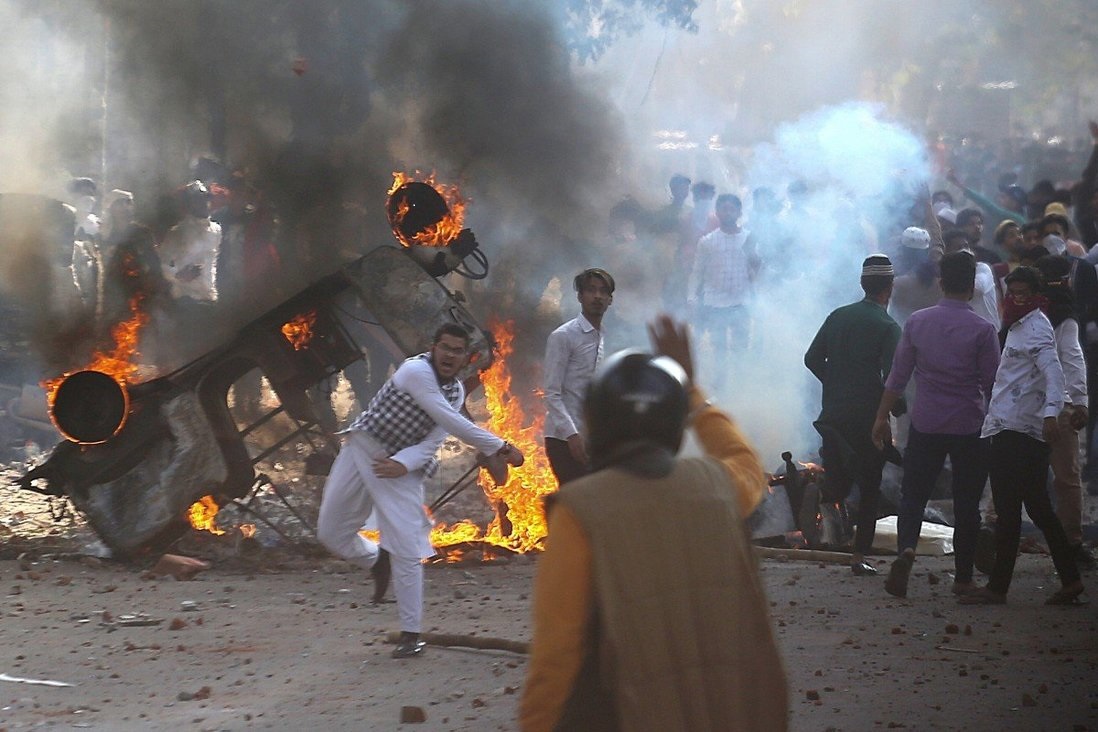
A 2021 report by Freedom House, a pro-democracy and non-profit organisation based in the United States, highlighted in its annual evaluation that India’s status had fallen from free to partly free in the year 2020 because of the policies adopted by the BJP government and its allies. Also, stringent measures against Muslims, media, academics, and civil society groups to pursue Hindu nationalist policies were other major causes of this decline. In addition to this, other factors included killing of Muslims in communal violence and protests in Delhi, charging students, journalists and citizens under criminal laws on speaking against government policies during the COVID-19 pandemic surge. In September 2020, Hindu extremists, involved in demolishing the historic Babri Masjid in 1992, were set free by a special court. The current government showed inclination towards building a Hindu temple on the disputed site.
Indeed when we talk about human rights, religious freedom, political rights and economic rights, fascist mentality and sham democracy has downgraded Indian electoral democracy to autocracy. The new farm laws by the authoritative BJP government were an attempt to compel farmers to sell directly to food processing markets and abolish the old method of state- controlled fixed price method. This would have directly led to lowering prices and the income of producers. In response to this, tens of thousands of farmers and peasants initiated tractor rallies and put the Red Fort under siege on 22nd January, 2021 – India’s 72nd National Day – to expose the draconian laws and suppressive policies of the Indian state. This was just another indication of BJP’s mentality of crushing the lower-class Hindus and minorities with stringent laws.
Similarly, the abrogation of articles 370 and 35A creates grave implications for regional security and stability. By such revocation, India is bringing demographic changes in IIOJK by turning the Muslim majority states into Hindu majority ones. This will alter the political, social, cultural and religious fabric of the society in IIOJK. Moreover, obliterating the Human Rights Commission in IIOJK, introduction of new domicile laws, implementation of new media policy and new land laws is an attempt to ‘Hindutvatize’ the region by extreme nationalist policies.
Contrary to its fake claims of being the world’s largest democracy, growing economy and champions of freedom, India is a classic example of a sham democracy, with a weak economy that deprives people of their basic civil rights. With the death of democracy, fascism rises. The problems with the health of Indian democracy lies in its compromise of civil liberties and democratic norms. No one will come to rescue deteriorating Indian democracy until a change is triggered from inside and this will unlikely happen till the BJP-led government is in power in India. Without such a change, India will remain a democracy in name only.
Asad Ullah Khan is a Senior Researcher at Centre for Aerospace & Security Studies (CASS), Islamabad, Pakistan. He can be reached at [email protected]
Image Source: Chowdhury Debashish Roy, 2020. “Analysis | What’s killing India’s democracy? It’s not just Modi who’s to blame.” South China Morning Post. March, 2020.