Concept Note
In today’s warfare Aerospace power has a pivotal role in exhibiting the national strength. The rapid pace of technological development is blending military, technological and economic dimensions to display the national power. For our region, which is confronted with challenges like regional rivalries, strategic alignments and aspirations of global relevance, the pursuit of advanced aerospace capabilities have become an element of paramount importance. India and Pakistan both are striving to gain an edge in aerospace power through their indigenous efforts, strategic alignments collaborations to integrate the modern technologies like, space based capabilities, drones, artificial intelligence, hypersonics and drones.
Iran, though often overlooked in South Asian analyses, has also invested significantly in indigenous aerospace development, with particular emphasis on UAVs, missile technologies, and space-launch capabilities. These efforts, achieved despite sanctions and isolation, add another dimension to the evolving aerospace environment of the broader region.
There is an undeclared race for arms and technologies to achieve greater deterrence, strategic autonomy and to accrue economic benefits. It is therefore important to critically evaluate the trends and trajectories of aerospace power in the region to understand their broader implications for security, stability, and development.
Objectives
- To assess the evolution of aerospace power in the region, with a primary focus on India and Pakistan, and a glance at Iran’s indigenous efforts.
- To analyse key technological developments shaping regional aerospace capabilities.
- To explore geopolitical drivers, partnerships, and dependencies influencing aerospace trajectories.
- To assess implications for regional security, stability, and future conflict scenarios.
- To recommend policy options for Pakistan in strengthening its aerospace posture and avoiding strategic vulnerabilities.
Theme
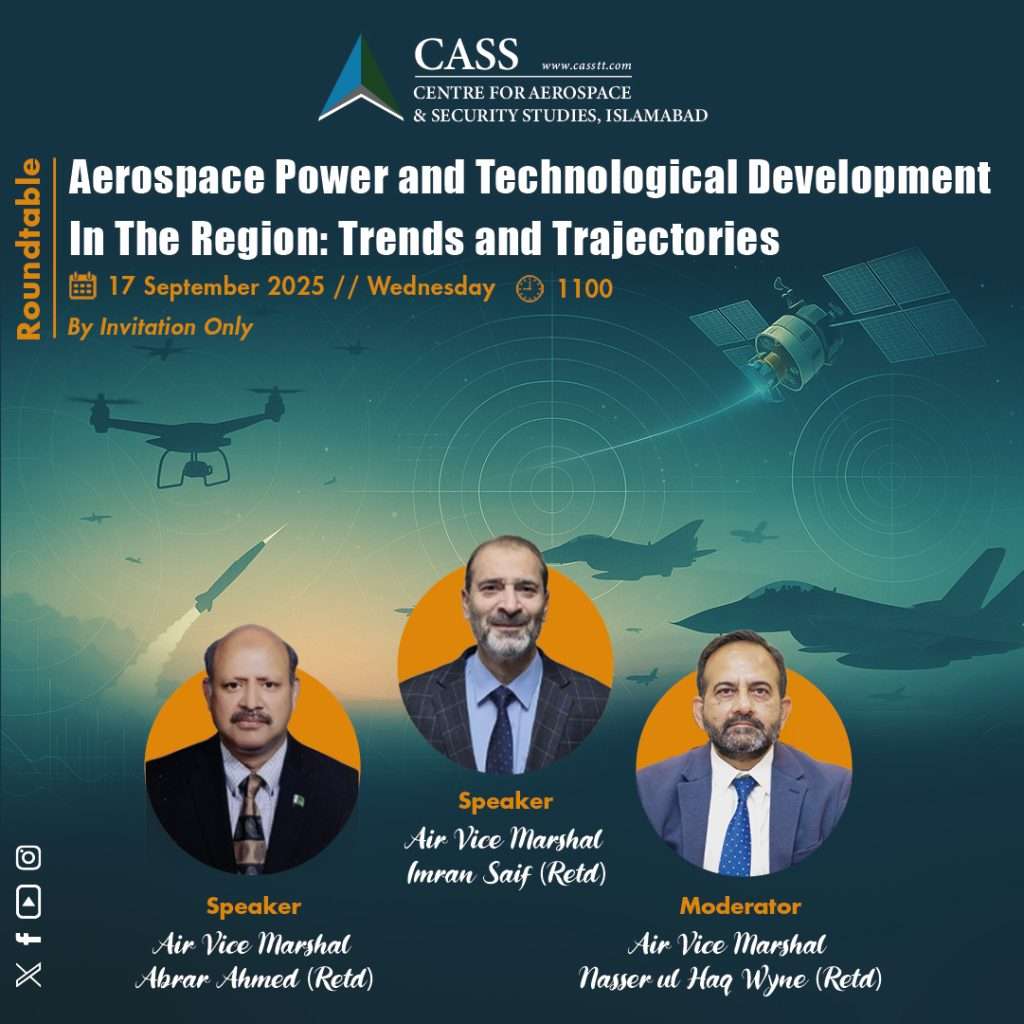
Speaker 1: Technological and Developmental Trends in Aerospace Power in the Region – 20 minutes
Guiding Question: How are technological developments shaping the future trajectory of aerospace power in the region, and what are the implications for Pakistan’s aerospace modernization efforts? Also discuss indigenous efforts by Iran, despite sanction.
Focus Areas:
- Current state of technological advancements:
- Combat aircraft (4.5th–5th generation).
- UAVs/UCAVs and counter-drone technologies.
- Space programs and dual-use technologies.
- Hypersonics, cyber integration, AI, and emerging aerospace enablers.
- Indigenous capabilities vs. reliance on external suppliers, with a glance at Iran’s indigenous efforts.
- Role of civil-military fusion and economic/industrial development.
- Assessment of where the region stands compared to global aerospace powers.
Speaker: AVM Imran Saif (Retd), AD
Speaker 2: Geopolitical and Strategic Dimensions of Aerospace Power in the Region – 20 minutes
Guiding Question: What are the strategic implications of evolving aerospace power in the region, and how should Pakistan navigate its geopolitical and security environment to ensure aerospace sovereignty?
Focus Areas:
- Aerospace power in the strategic doctrines of India and Pakistan.
- Role of external powers:
- India’s partnerships (U.S., France, Israel, Russia).
- Pakistan’s reliance on China and selective partnerships.
- India-China competition and its spill over into South Asia.
- U.S. Indo-Pacific strategy and its implications for regional aerospace balance.
- Iran’s technological strides and their strategic impact on the regional balance.
- Impact of aerospace modernization on deterrence stability and escalation risks.
- Future trajectories (10–20 years) and their effect on regional stability.
Policy recommendations for Pakistan to strengthen its aerospace posture and avoid vulnerabilities