The rise of BJP, as a major political force, has been paralleled by the progressive decline of the Congress Party, which ruled India for 46 years of its half a century post-independence age. The main factors underlying the decline of the Congress revolve around its greed, lust, and hunger for power. As a ruling party, the Congress consistently thwarted the aspirations of all sections of the common people, allowed poverty to intensify in large proportions and undermined the security of minority communities, Dalits, and the rural and urban poor.
According to Stanley Kalpage, ‘BJP wields much influence with upper caste Hindus and among the business community and professionals’ A growing new Indian middle class also supports the party. It earned only two seats in the 1984 elections but raised the tally to 161 in the 1996 Lok Sabha elections. The phenomenal rise in its popularity in such a short period raises questions about the programmes and promises it makes to Indians. Kalpage also notes that ’in 1987, a wave of Hindu revivalism swept through India when the ‘Ramayana’ (Romance of Rama), the most popular of all Hindu epics, was being shown on national television. The ‘Ramayana’ was adapted for television by Ramanand Sagar, a successful producer of Hindi films. Everyone enjoyed the serial, which was screened for 104 weeks. The success of ‘Ramayana’ prompted the Indian government, who immediately tasked B.R. Chopra, another celebrated Indian film producer, to adapt another Hindu epic, the ‘Mahabharata’ for their television network. Chopra produced a 93 hour-long television serial of the epic, which proved a great success. These two epics depicted the evolution of Hinduism from 400 B.C. to 200 A.D. According to Kalpage, these serials opened the floodgates to the Hindu revivalist tide. Congress Party members, and other critics of the BJP, link the rise of the BJP with these two TV serials. Since 1987, the leaders of the BJP have exploited the religious mood that the serials created.’
Now, well settled in power since 2013, Stanley Kalpage’s analysis that the ‘BJP is seen to be leading the challenge to at least two of the four cardinal principles of Nehru legacy-secularism, socialism, non-alignment and democracy, which they feel has left India, poor and vulnerable’ is still holding strong. The BJP’s philosophy, programmes, and priorities, are not in line with the spirit of secularism.
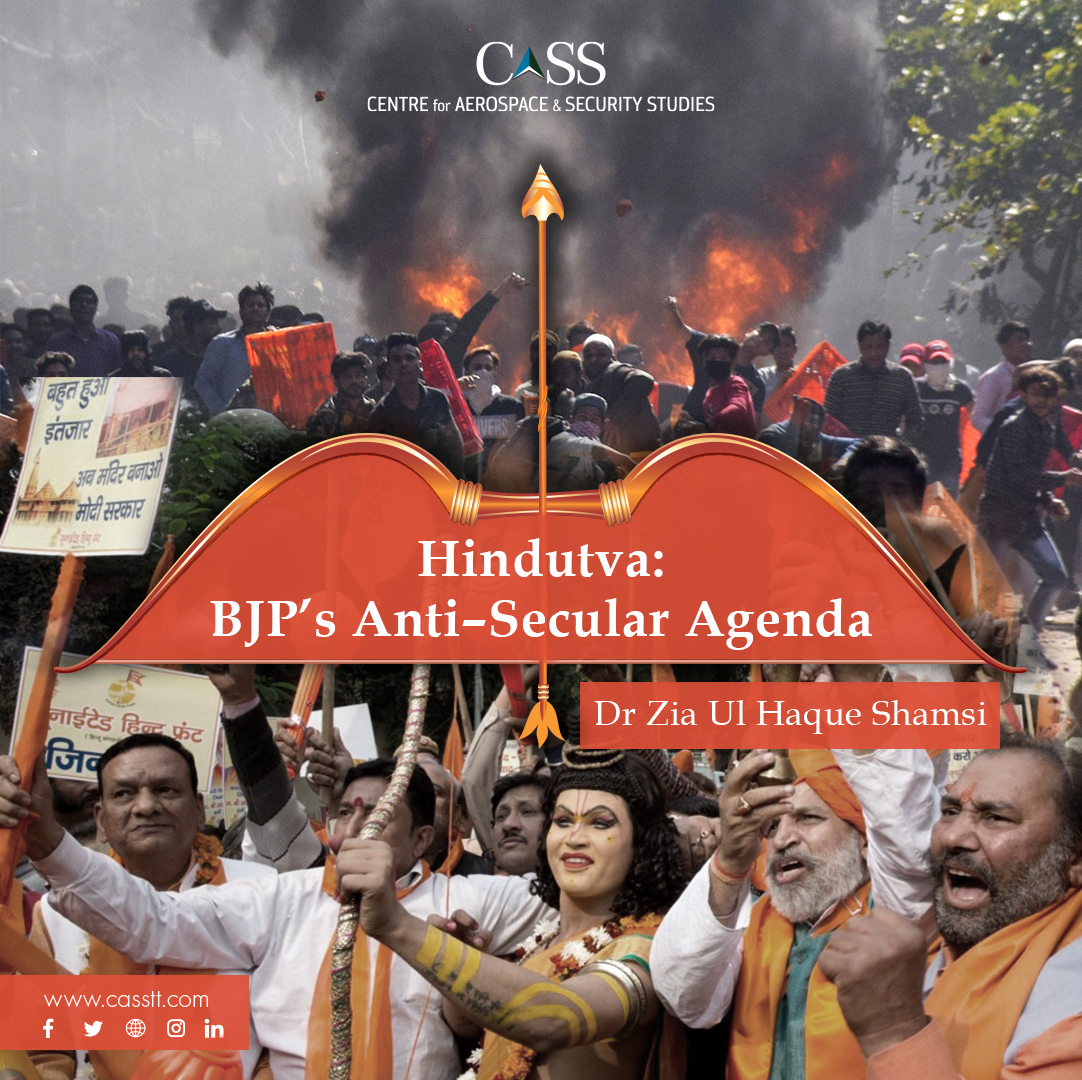
‘Hindutva’, as BJP claims is not a religion but a philosophy like communism or socialism. However, the reality is exactly opposite to this claim. ‘Hindutva’ is nothing but the revival of Hindu religion and culture as practiced by the majority population of India. Its proponents are Hindu fundamentalists. They have politically organised themselves and are gaining enormous support in the Hindu heartland. The political appeal for Hindu voters of India, lies in their being not only anti-Muslims but being anti-all religions. Hindu fundamentalists perceive Islam to be the rival religion. They know that they cannot reverse the historical divide that has taken place. But, according to M.G. Chitkara and B.R. Sharma (1997), they want all Indians, in particular, the Muslims to accept the Hindu culture as their way of life.
Vijay Malhotra, right in the early years of BJP’s rule, outlined Hindutva fundamentals, as preached by the BJP and other Hindu fundamentalists. Malhotra categorically stated that, ‘Hindutva and Indian nationhood are synonymous terms. All those living in this country are Bharatiya or Hindus. Here no one should take exception to this truth.’ Therefore, whatever is happening with the religious minorities, is not by an accident or an afterthought, but a concerted effort of a well-thought-out strategy.
The recent outburst by a BJP leader against the Holy Prophet (Peace be Upon Him) has irked a number of Muslim states, perhaps for the first time in this fashion. Most Muslim leaders are demanding an apology from the Indian leadership and called for the boycott of Indian products across these states. However, the Modi government does not really care about these actions by smaller countries in which millions of Indians are working since decades and remit billions of dollars every month. Rather, India is seriously contemplating to counter this socioeconomic boycott by some Muslim states and imposing similar actions against popular regional airlines which carry large number of Indian nationals across the globe.
On the other hand, Pakistan’s reaction is relatively lukewarm compared to past incidents that have taken place in some European countries. This is unusual, not only on part of the government but also on part of the right-wing political parties who would block the Federal Capital at will in the past on the similar incidents.
Pakistan must take a firm stand on the incidents related to Islamobhobia that has been recognised as a legitimate concern of the second largest community of the world, by the United Nations as well. It may be necessary to remind that appeasement is a failed strategy in international affairs following the precepts of realism.
Dr Zia Ul Haque Shamsi is the author of ‘Nuclear Deterrence and Conflict Management Between India and Pakistan’ and ‘South Asia Needs Hybrid Peace.’ He is presently working as Director (Peace and Conflict Studies) at the Centre for Aerospace & Security Studies (CASS), Islamabad, Pakistan.