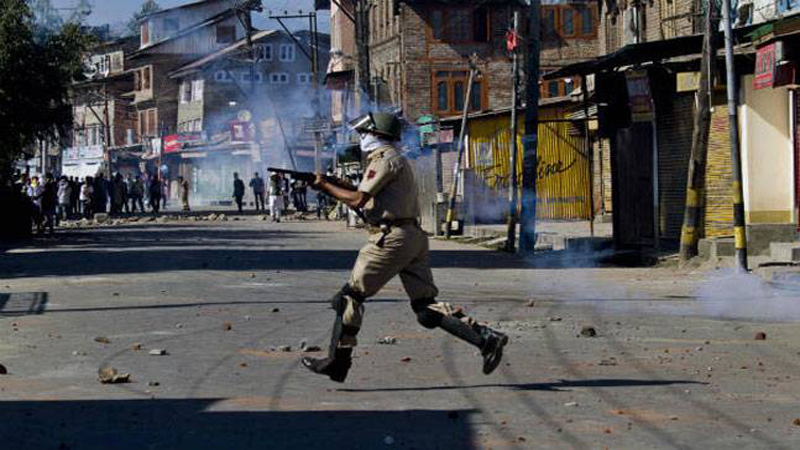
This February marks the sixth month of curfew imposed on Kashmir. The curfew that was expected to last some days has now entered a stage where it is extremely strenuous to predict as to when it would be lifted. The Indian government is still not letting the Kashmiri population live a normal life and is adroitly defining new standards of normalcy where they are expecting that people who are deprived of their basic human rights to bow their heads in front of the belligerent and inhumane actions. It’s the sixth month and the Kashmiri people continue to remain in a caged environment which the Home Minister, Amit Shah defines absolutely “normal”.
Prominent Kashmiri leaders such as Mehbooba Mufti, Omar Abdullah and Shah Feisal continue to remain in detention since August. Furthermore, Omar Abdullah and Mehbooba Mufti have been charged under the Public Safety Act (PSA), a law permitting detention without trial for up to two years as the detention under the current charges were not allowing detention more than six months. A few other Kashmiri politicians have also been arrested and kept in unknown locations on the pretext of security constraints. The Public Safety Act has been condemned on a number of platforms and has been termed as “draconian” by Amnesty International. The Modi regime has been very active in delivering its election promises which remain to be controversial and full of hatred towards the Muslim community.
While there is tremendous efforts by the Indian government to portray as if everything is back to routine, the fact of the matter is that the government is controlling the routine affairs of the people of Kashmir and internet and mobile services continue to remain suspended in the region till yet. A large number of individuals have been arrested by the Indian government in order to quell any sort of resistance. The voices of Kashmiris remain suppressed and even two Indian journalists were probed when they attempted to cover a strike which was called in Kashmir. Likewise, a number of Kashmir-based newspaper have been banned while only three local newspaper are allowed to operate on the premises that no news criticizing the Indian government’s action in Kashmir will be published.
The deprived Kashmiri population has even resorted to suicides in order to escape the torture imposed upon them. The plight of the innocent Kashmiri population continues to be thrusted aside and they seem to be forgotten by the Indian media and politicians. The Indian armed forces have been a part of the horrendous move instigated and a number of people have been killed in Kashmir after the imposition of curfew.
5th February in Pakistan is celebrated as Kashmir Day in order to show unity with the Kashmiri people for their right of self-determination. On this Kashmir Day, the Pakistani Prime Minister Imran Khan addressed the special session of the AJK legislative assembly in Muzaffarabad, Imran Khan stated that Pakistan will take steps to intensify its efforts to highlight the plight of the Kashmiris at the international platforms. Previously, Pakistan has taken the issue at United Nations, Refugee conference in Geneva and in the meetings with a number of heads of states. Khan once again reasserted that this bottling up of nationalism in India will have negative consequences as it would be impossible to roll it back after it crosses a certain threshold by stating “If Modi could not step back his policies of racism and nationalism in the form of Hindutva would wreak havoc upon India”.
Recently, India has taken even more controversial steps such as passing of the Citizen Amendment Bill (CAB) and National Registry of Citizens (NRC) which aims to draw lines along religious identities of the individuals living in India. The current government under Imran Khan is determined to give substantial importance to the Kashmir issue. However, Pakistan needs to adopt a new approach towards this issue in order to defeat the Indian efforts to divert attention from the atrocities that are being practiced in Kashmir.
Moreover, Pakistan should be prepared to deal with more India hawkish policies. Many senior politicians in New Delhi including the Home Minister Amit Shah have signaled that India should exercise its physical jurisdiction over Azad Kashmir, The newly appointed Army Chief of the Indian armed forces at a forum stated, “If parliament desires that area (Pakistan administered Kashmir) to also become our part at some point and if we receive any orders to this effect then action will definitely be taken. The statement by the army chief along with a number of other belligerent statements signals how the government is completely comfortable with new approaches that involve the use of force in the disputed territory.
Furthermore, If India can unilaterally revoke the status of a disputed territory, there are ample reasons to suggest that India can also attempt to execute other aggressive policies, one of which the experts point to would be to withdraw from the Indus Water Treaty (IWT). It should be kept in mind that for the next four years, Modi and his religious fanatic regime and it may be reelected for the next election as well due to the reason that the only rival party Congress is continuously failing to get itself together and bolster its political stature. Hence, Pakistan should expect irresponsible activities from the Indian side in future.
While speaking to a ceremony to mark the Kashmiri Solidarity Day, Islamabad’s permanent representative to United Nations, Munir Akram has stated that it is due to Pakistan’s efforts that the Indian atrocities have been highlighted an brought into the international community’s attention after a period of fifty years and the UN has addressed the Kashmiri issue three times in 6 months .Moreover, the UN Secretary-General Antonio Guterres and a number of other UN officials have condemned the Indian action in Kashmir
Akram further elaborated that Pakistan’s approach towards the Kashmir is three-pronged which involves accentuating the conditions of human rights in Kashmir, reaffirm the legitimacy of the freedom struggle of Kashmiri people based on their right of self-determination and ultimately reach a political consensus on the issue which has been lingering on for decades through peaceful measures and not involving any force. Kashmir apart from being a nuclear flashpoint has turned into a serious humanitarian crisis.
The imposition of curfew was a norm for the people of Kashmir but the recent curfew has taken a very dangerous form. In his historic speech at the UN, Imran Khan aptly warned the international community that it must take into account the lethal actions that are being practiced in Kashmir. Pakistan has always shown its appetite for engaging in a constructive dialogue with India. However, the Indian regime has shown no reluctance in stone walling any peace gesture by Pakistan. As far as Kashmir is concerned, India has shown even more arrogant behavior and is continuing to take unilateral steps without any hesitation.
China, Iran and Malaysia have spoken quite loudly on the developments taking place in Kashmir. Finland, Germany and Sweden have also shown their concerns over the issue. Similarly, the Organization of Islamic States (OIC) have also expressed a strong statement. The President of Azad Jammu and Kashmir (AJK), Sardar Masood Khan stated that in such times the Kashmiri diaspora has been a ray of light which has played its part in spreading the plight of the Kashmiri people. Khan highlighted the role of the Kashmiri diaspora in United Kingdom, Europe and North America which have taken the issue to the civil society, media ad lawmakers. Prominent parliamentarians in British Parliament, Congress and European Parliament have raised voices against India’s action on abrogating the special status of Kashmir. However, the major powers have shown somewhat of an ambiguous response towards India due to their strategic and economic interests. This silence can roll out in lethal repercussions with far-reaching consequences.
The writer is a researcher at Centre for Aerospace and Security Studies (CASS). She can be reached at [email protected]