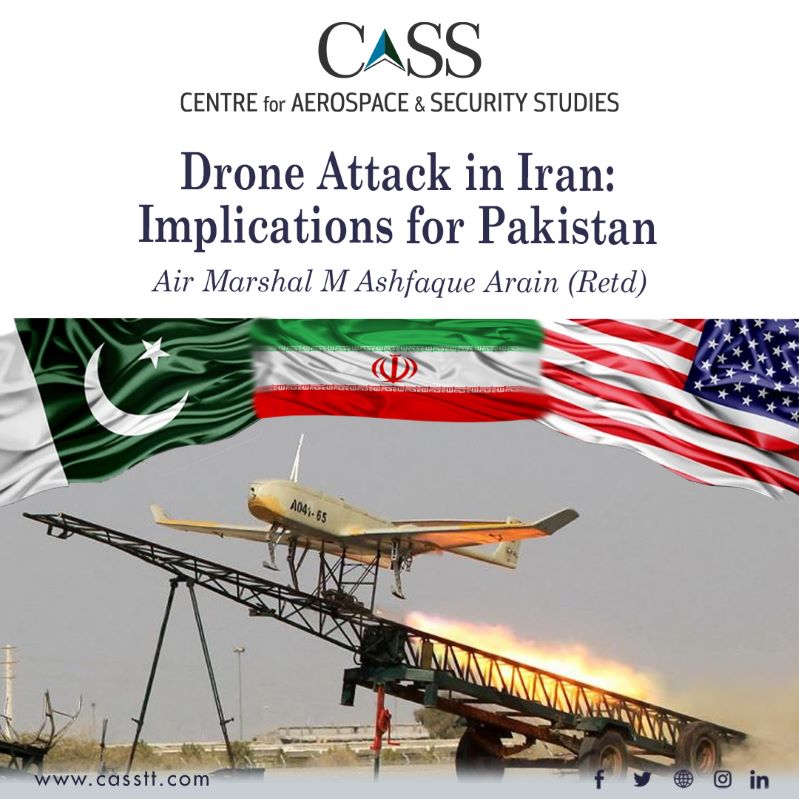
Three drones carrying explosives attacked a defence facility in the Iranian city of Isfhahan on Saturday night at around 1130pm. There have been conflicting reports on the damage caused. According to Iran’s official news agency IRNA, two of the three quadcopters carrying bomblets were destroyed, and there was minor damage to the building’s roof with no casualty. On the other hand, Western media reported a huge fire at the attack site. Footage of the downed quadcopters shown by the state-run TV suggests these to be commercially available systems. Incidentally, around the same time, a fire broke out in a refinery in the north-western part of the country.
Isfahan houses an air base, Nuclear Fuel and Research Centres, drone factory and missile production site. The Iranian Defence Ministry identified the target as a workshop without giving details. Different media sources have, however, identified the target to be either a nuclear facility, a drone manufacturing factory or missile production centre. Being inside a populated area, this is not likely to be a nuclear facility or a missile production facility. Since the West, led by the US, is not happy with supply of Iranian drones to Russia, it is very probable that the target was a UAV manufacturing factory. Western mainstream media’s emphasis on the target being a nuclear facility seems an effort to convince their public of the legitimacy of the attack, as targeting a nuclear facility is more acceptable to masses.
While earlier, the US and its allies, especially Quad-2 partners, were against Iran’s nuclear and missile programmes, now they are also not happy with its indigenous UAV capability, especially after these have been supplied to Russia for use against Ukraine. Additionally, the strike was timed with US Secretary of State Antony J. Blinken’s visit to Israel. Interestingly, CIA Director William J. Burns visited Israel just a week prior to the attacks. According to New York Times, the attacks were carried out by the Israeli intelligence agency Mossad. All these suggest US connivance and interests.
US interests are not limited to damaging / delaying Iran’s nuclear programme or missile and UAV capability. After her unceremonious exit, the US is also interested in retaining her distant control over Afghanistan. Under US duress, the Taliban government has not been accepted by any country. Washington, in addition to monitoring Kabul, is also interested in retaining the capability of undertaking air operations in the country. Additionally, to retain its global influence, the US is also continuing with its ‘China Containment Policy.’
These three Countries of Interest (CoI) require that the US maintain its monitoring as well as physical intervention capability. Monitoring necessitates intelligence gathering through electronic surveillance and human intelligence. In addition to satellites, these activities can be accomplished through UAVs and specially equipped aircraft. Washington’s objectives in the region, hence, require physical presence at a suitable location which can facilitate monitoring of all three countries with ease. Pakistan, because of its location, becomes the most appropriate option.
At the moment, Pakistan is going through political turmoil and economic hardships and badly requires financial assistance. The International Monetary Fund’s help is essential to repay debts due in the coming months and get additional assistance to revive the economy. Given its clout, the US has the ability to use IMF for arm-twisting.
In the recent past, there has been a very rapid rise in the number of terrorist incidents in the country, latest being in Peshawar which claimed more than 100 precious lives. During a recent visit of Pakistan’s Foreign Minister, the US offered assistance in countering the menace of terrorism in the country. However, details on the type of assistance offered are not available. Social media is rife with news of a US delegation’s recent visit to Pakistan, though there has been no official confirmation or denial. The IMF team is also present in the country to discuss release of a badly needed next tranche.
Pakistan is centrally located and shares borders with the three CoI, once again enhancing its significance. The US could be interested in having a base in the country and permission to use its air space for surveillance as well as for flights of its attack aircraft and UAVs.
The three countries of US interest are Pakistan’s immediate neighbours. Assisting the US in its objectives against these countries will surely affect Pakistan’s relationship with all of them. Pakistan must not forget the lessons learnt from its earlier experiences of supporting the US in its military operations in Afghanistan. While our support during the Afghan resistance against the USSR resulted in gun culture and narcotics in the country, our support to US post 9/11 resulted in loss of over 80,000 precious lives and more than USD 100 billion in economic terms. Instead of acknowledging Pakistan for its contributions and sacrifices, the US obliquely blamed us for duality of role.
Pakistan’s cooperation with the US against neighbouring countries will have serious implications. At the same time, not cooperating with the US will have its own set of challenges. Pakistan must, therefore, make decisions keeping in view its national interests, long-term implications of creating distrust with all its neighbours, and the impact of such a decision on its internal security and national cohesion.
The author is a retired Air Marshal of the PAF who served as Pakistan’s Air Adviser at New Delhi from 2002-2006, presently working as Advisor to CAS on CASS Affairs, and Director Emerging Technologies and International Coordination at the Centre for Aerospace & Security Studies, (CASS), Islamabad, Pakistan. The article was first published in The National Herald Tribune. He can be reached at [email protected].