
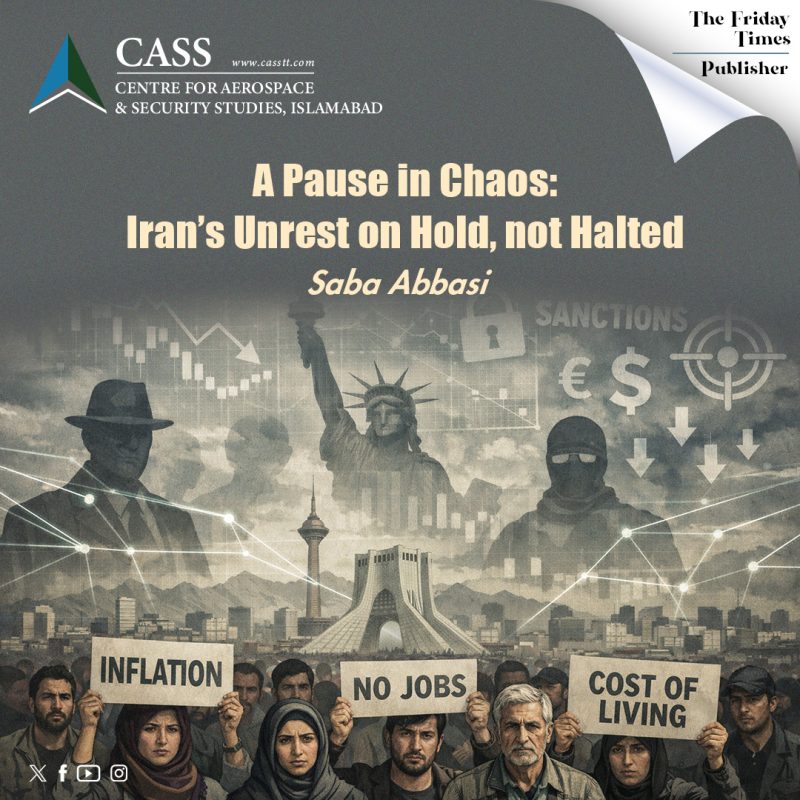
Economic dysfunction has been a consistent reason for riots in recent years. Countries such as Bangladesh, Srilanka, Nepal, and most recently Iran witnessed mass protests emanating from economic turmoil. Unemployment, inflation, and mismanagement of resources led the masses to express their discontent through protest and strife.
The ‘educated unemployed’ class, which historically has been known to be one of the reasons for the outbreak of World War I, also remained the cause of mayhem in South Asia. However, in the case of Iran, the disillusioned and frustrated masses were exploited by external elements to widen the fault lines between the state and its people.
In the recent Iranian case, protests began in downtown Tehran due to economic dissatisfaction and a steep currency slump. Localised and peaceful protests, commonly regarded as indicators of a politically conscious and aware nation-state asserting its rights, were morphed into a foreign-led instigation.
The bluntness with which the external actors instigated unrest in Iran was a distinctive element of these riots. President Trump and Prime Minister Netanyahu unabashedly egged on the otherwise benign protestors to create anarchy. Not only that, MOSSAD’s Persian language Twitter account openly boasted about its agents being on the ground and side by side with Iranian protestors. The peaceful protests were hijacked by Israeli agents, turning them violent and out of control. The protestors were instigated, armed, and coordinated by MOSSAD’s agents to trigger instability and erode the regime’s control over the situation, thus employing a potent regime-change playbook tactic. Moreover, as the Iranian regime tried to suppress the protests, it faced threats of attack from the POTUS.
The full spectrum of the USA’s kinetic and non-kinetic means of war against Iran was aimed at regime change. The confluence of economic warfare in the form of long-held sanctions, coercive posturing, the war of June 2025 and intimidations of yet another kinetic strike on Iran were all aimed at uprooting the regime. Nevertheless, Iran withstood the USA–Israel’s full suite of military and coercive tools. For Iran, adversity bred resilience, but brought with it sobering lessons.
Iran holds the third largest oil reserves in the World, despite this, its economy is seriously constrained. This is largely because Iran’s natural resources and nuclear potential have always exposed it to external pressures in the form of sanctions and market manipulation, thereby weakening its economic sovereignty. Consequently, it becomes imperative for a resource-rich country to have the means to protect those resources and treat them not just as commodities but as strategic assets. As recent events show, resource-rich countries that lack the capability to defend or independently manage their assets become targets of foreign interference that results in internal instability and economic regression.
Furthermore, the normalisation of external intervention in the matters of sovereign countries is another takeaway from the Iran riots case. Powerful states feel increasingly unrestrained to step out of bounds to meddle with other countries’ affairs, with no heed for international laws and norms. Without accounting for one’s own atrocities and violations, the USA and Israel continue to make threats against the Iranian regime for its attempt to manage internal matters.
Iran riots and the USA’s role in it can also be seen in the context of the USA and Israel’s concern regarding Iran’s nuclear and missile program. Iran’s defence and nuclear capabilities have always been met by aggressive pressure from the two countries. President Trump has time and again expressed his willingness to go to any extent to keep Iran from developing its military capabilities. Hence, the series of recent events, Israel’s inherent insecurity and the USA’s coercive posture towards Iran make it unmistakably clear that the USA and Israel will repeatedly go to lengths to defang Iran.
However, an internal regime change demands certain prerequisites; a military coup, or a revolution. The USA’s ambitions to intervene under the guise of an internally driven regime change in Iran failed because the necessary prerequisites were not met. First, Iranian army remains loyal to the regime, and moreover the Iranian public was not unanimously opposed to the current regime either. More so, having seen the decades-long state of affairs in the region starting from Libya, Afghanistan and Iraq, after the American intervention, Iranian populace could not be further away from trusting USA to usher them into a golden age. Nevertheless, The US strategy of touting Shah’s son as an alternative to the current regime also backfired as he prematurely revealed his hand and undermined his image by pledging to recognise Israel, end Iran’s nuclear program, and expand the Abraham Accords.
Although recently Iran succeeded in abating riots while retaining the current regime, the future still remains uncertain. Given the ongoing US military deployments near Iran’s waters, the likelihood of military confrontation is intensifying again. As Trump makes renewed threats, and with Iran avowing severe retaliation, the prospect of another war has almost become a matter of eventuality, with the previous abatement of turmoil just being a temporary respite. Predictably, to lock horns with Iran would be an underestimated challenge for the USA. Considering that the Strait of Hormuz and regional US air bases are within Iran’s access, any action by Iran, in response to USA’s aggression or intervention can beget serious geoeconomic and military consequences for the USA.
Saba Abbasi is a Research Assistant at the Centre for Aerospace & Security Studies (CASS), Islamabad, Pakistan. She can be reached at [email protected]



