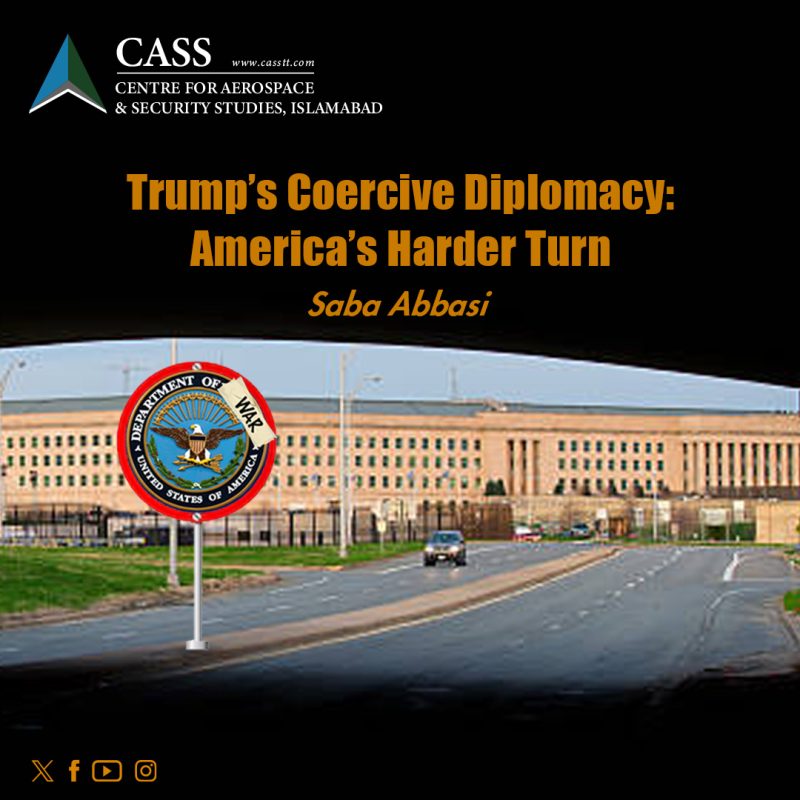
President Donald Trump renamed the Department of Defense (DOD) to the Department of War in September 2025. Then, just a month later, he threatened at least three countries with war. Trump’s economic war was waged on most states, in the form of tariffs, from the day he assumed office, but the threats and signalling toward an armed confrontation have been growing more frequent and explicit.
In the White House statement about Trump’s executive order to rename DOD, it was stated that the name Department of War will ensure peace through strength, because it demonstrates the ability and willingness to fight and win wars. It also stated that the name “shall sharpen our adversary’s focus on our willingness and availability to wage war and secure what is ours.”
The use of the word willingness twice signals something deeper: a readiness for war. Although the mention of the USA’s military ability in an occurrence of conflict is unsurprising and predictable, given its vast arsenals but the reference to the availability to wage war and secure what America deems its own is meaningful and controversial. The willingness to initiate a war and the entitlement to unilaterally decide on what base the war can be waged are mostly the essence of Trump’s executive order.
In the wake of the statement, the ongoing situation between Venezuela and the US reflects Trump’s appetite for war. The placement of the world’s largest aircraft carrier in the Caribbean and carrying out B-52 Bomber flights around Venezuela begs explanation – Why does a country like the USA, which is hundreds of times larger in economic and military power, has to station its largest aircraft carrier around a much smaller country already grappling with its economy?
While the USA cites fight against the narco-terrorists as its rationale, analysts contend that it is about signalling and striking fear in the hearts of Venezuelan military and Prime Minister Maduro’s inner circle, so as to meet the ends of regime change. Trump’s coercive tactics are aim at establishing dominance and determining who governs. Maduro himself accuses Washington of ‘fabricating a new war’.
Venezuela is not an isolated case of Trump’s war mongering; in another instance, Donald Trump called Nigeria ‘a disgraced country’. He said that the US may very well go into Nigeria “guns blazing” to wipe out Islamic militants that, according to him are carrying out targeted killing of Christians. After warmongering, Trump moved to next phase of coercive diplomacy in which his War Secretary, Pete Hegseth, met Nigeria’s National Security Advisor. After the meeting, Hegseth posted on his social media about the “aggressive” work the USA has been doing with the Nigerian government and demanding that Nigeria show its commitment to curb terrorism.
The diplomatic arm-twisting by the American President shows his detachment from the realities on the ground in Nigeria. American administration fails to understand that what is happening in Nigeria is not a policy of neglect but a problem of capacity. The reasons for violence in Nigeria are far more complex than what Trump portrays. Contrary to Trump’s narrative, the militant groups in Nigeria are targeting Christians and Muslims alike. There are other internal overlapping factors, such as Muslim herders and Christian farmers fighting over land and water, and armed bandits who are carrying out abductions for ransom. All of the internal turmoil that the Nigerian government is enduring domestically worsens because of the USA, a superpower, threatening to attack them in a fast and vicious way.
It seems that Trump’s motto is ‘war for peace’. It is difficult to determine whether, with his rhetoric and signalling, he is deterring states or enticing them to attack. As later occurred in Venezuela when its military forces were mobilized, but not out of bravado but fear and defensiveness for its sovereignty. Previously, Trump called for resuming nuclear weapon testing to keep peace with other countries such as Russia and China. He also stated that China will not take military action on Taiwan during his term because Xi knows the “consequences” of such an action. In the lexicon of contemporary diplomacy, such statements reflect coercion under the guise of reassurance. Not to forget the 12 day Israel-Iran war during which USA acted as a facilitator of aggression rather than a keeper of peace.
Trump’s policy of America First is now translating into America alone because of his explicit threats to smaller states and implicit threats to other global powers. American diplomacy is now increasingly conducted through the language of force to demonstrate assertiveness and shape the adversary’s behavior. Trump’s rhetorical militarism is a double-edged sword as it erodes the distinction between deterrence and provocation, blurring the line between stability and escalation. The contrast between Trump’s aspirations for a Nobel Prize and his propensity for warmongering is curious. It also represents a departure from values-based foreign policy that has historically defined the USA’s identity on the global stage.
Saba Abbasi is a Research Assistant at the Centre for Aerospace & Security Studies (CASS), Islamabad, Pakistan. She can be reached at [email protected]