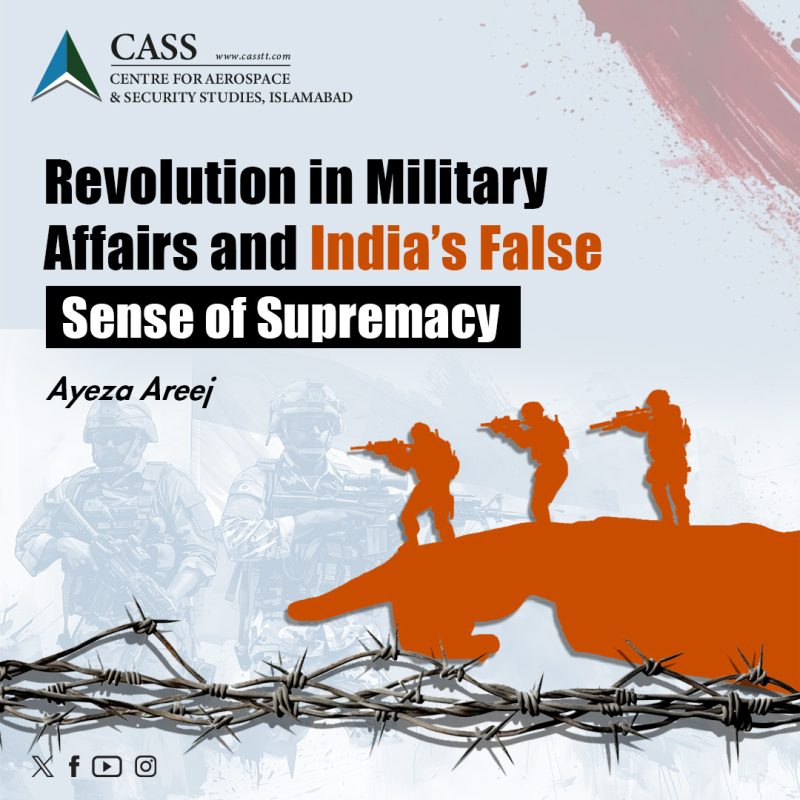
When technology leads the way to strategic dominance, military incursions begin to look commandable and clean. The ‘Revolution in Military Affairs (RMA),’ in essence, is the integration of military and technological systems that results in notable doctrinal, organisational and tactical transformations for military. However, it greatly impacts the behaviour of military and political leaders. The precision strikes and limited conflicts are the two biggest illusory appeals of RMA. Consequently, state actors are willing to undertake surgical strikes while disregarding the risks of escalation and major repercussions. The RMA pursuit results in reckless behavioural outcomes, such as the ‘risk compensation and risk transfer militarism.’ According to Ulrich Beck’s idea of risk compensation, technological superiority acts as a catalyst for states to engage in dangerous kinetic entanglements by infusing a false perception of safety in state actors. Simultaneously, risk-transfer militarism shifts the dangers and the cost of conflicts towards their opponent through distant warfare strategies.
The manifestation of this paradox is clearly visible in India’s consistent pattern of surgical air strikes and limited military incursions, demonstrating its growing tendency to accept risks and trigger conflicts, which it apparently seems to prevent. Aggressive behaviour and strategic missteps of Indian leadership strongly reflect this belief, however, it often boomerangs. India, under the Modi regime, focuses on advanced defence technology, which highlights its RMA inspired mentality. Resultantly, there is a significant rise in India’s defence budget. The budget showcases a substantial increase to about 6.2 trillion INR in the fiscal year 2024-2025, which is more than 170 percent rise in the past ten years. New Delhi has acquired various military technologies in pursuit of military modernisation and strategic ascendency. Endeavours like “Make in India’’ promote indigenisation of military hardware that further advances the very same mind set. Numerous military inductions clearly depict ‘‘India’s Land Warfare Doctrine’’ operationalisation, which specifically emphasizes on surgical strikes, punitive destruction and force modernisation.
Consequently, India no longer views surgical strikes as the last option, but as a ‘repeatable tool of statecraft’ to attain domestic legitimacy and political goals. It provides false sense of supremacy and overconfidence to India to undertake pre-emptive aggressive actions against Pakistan. As evident in the Balakot surgical strikes (2019) and Operation Sindoor (2025), assumed tech-driven invincibility emboldens New Delhi to conduct stand-off strikes while transferring the political and human costs onto Pakistan. Thus, New Delhi’s pursuit of RMA results in its overreliance on technologies, significantly lowering the threshold for kinetic engagement in the South Asian region.
Operation Sindoor portrayed how technological overconfidence can backfire, as Pakistan’s integrated kill chain and multi-domain operations during Marka-e-Haq turned New Delhi’s RMA-driven strategic ambitions to its own detriment. While also working on RMA, Islamabad always focused on defensive adaptability rather than offensive action or technological hubris. It employed a sophisticated integrated kill chain through a multi-domain operation synergizing advanced aircrafts, cyber capabilities, electronic warfare platforms, beyond visual range missiles, drone assets and ISR systems. Against the numerical advantage, Pakistan Airforce shot down four Rafales, one Mirage 2000, one Su-30 and a MiG-29. Pakistan’s response demonstrated that integrated systems and multi-domain operations set the outcome in modern combats.
Despite setbacks, India is determined to accelerate its military modernization. After the Pahalgam episode, Indian Ministry of Defence released a “Technology Perspective and Capability Roadmap (TPCR)” in September 2025, which aims to build a future military centred on the fusion of AI, space, cyber, unmanned systems and preparedness for nuclear threats. The document also highlights that India will prioritize modernisation in AI- loitering and stealth drones with approximately 1,500 km range and 60,000 ft altitude, alongside jamming platforms to disable drone swarms covering 15 km radius. Furthermore, Indian pursuit of Agni-V and Agni-Prime ballistic missiles highlights its continuous reliance on advanced defence capabilities. However, this persistent overreliance on military hardware rather than strategy and illusion of controlled war encourages India to take strategic risks against a nuclear state. Therefore, such a misadventure remains a plausible option for New Delhi, consistent with its old political and military playbook.
These trends necessitate proactive strategies and efficient planning. As a way forward, armed forces of Pakistan should focus on the enhancement of multi-domain operations through synchronisation of multiple domains including cyber, space, land, air and sea, ensuring adaptability for future conflicts. Alongside, Pakistan should focus on sustaining a constant high readiness posture through swift rapid reaction strategies, forward ISR and defence of critical assets to avert Indian incursion.
Ultimately, India’s ambition for technological superiority without effective strategies, skilled human resource, operational efficiency and integration of systems would only result into a liability for Indian leadership rather than strategic advantage. In South Asia, eventually, strategic pre-eminence will be determined by operational proficiency and adoptive organizational growth rather than the material strength alone.
Ayeza Areej is a Research Assistant at the Centre for Aerospace & Security Studies (CASS), Islamabad, Pakistan. She can be reached at [email protected]