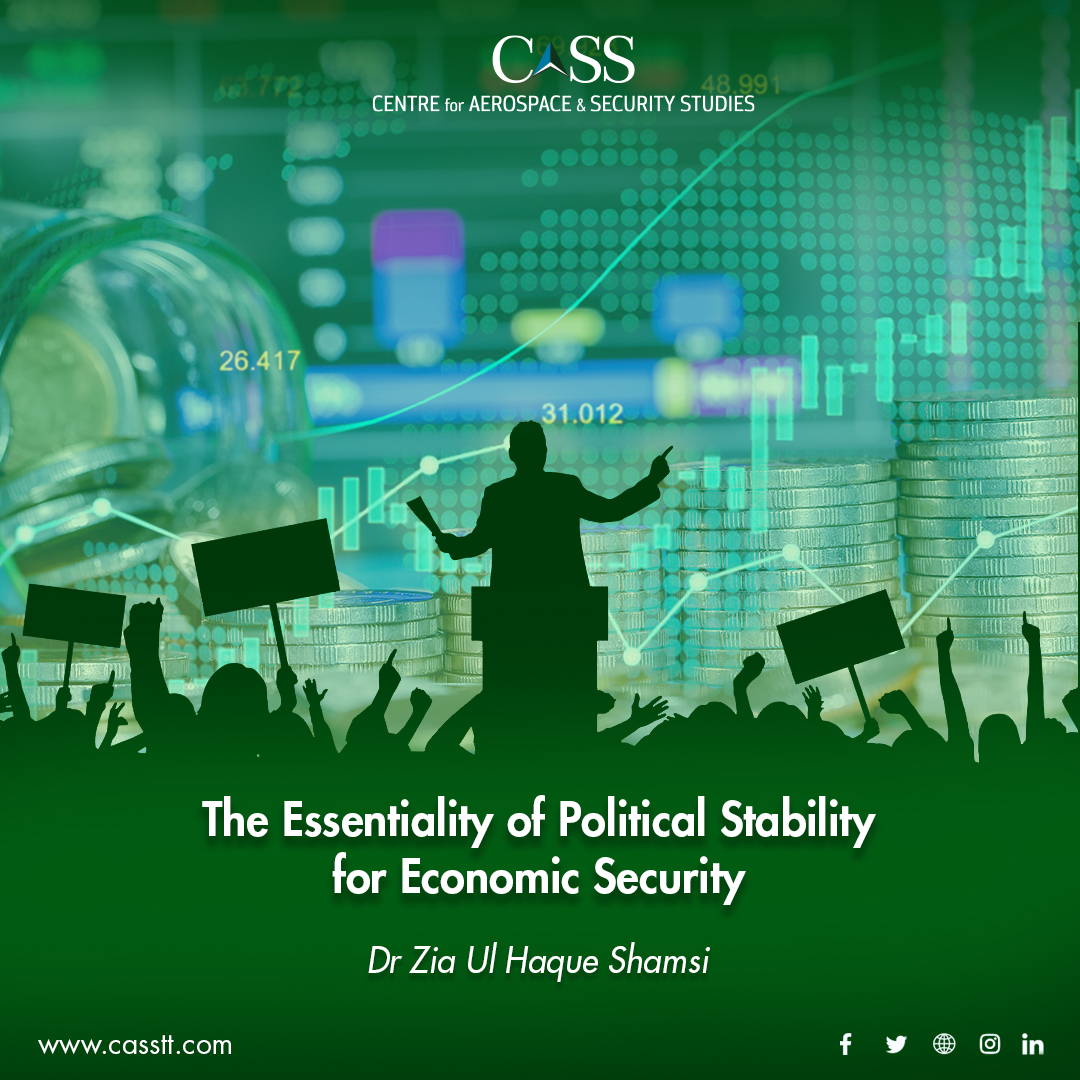
Political sloganeering during an election campaign is a usual phenomenon across the globe, because according to Carl Von Bismarck’s dictum, “Politics is the art of the possible.” For the same purpose, political actors design their campaigns to gain public support and come into power to supposedly serve the people.
One such political campaign, which kept the economy as its main driver with an extremely appealing phrase, “The economy, stupid,” was coined by James Carville in 1992. Carville, who was Democrat Party’s candidate in Bill Clinton’s successful 1992 presidential campaign against incumbent George H W Bush, is generally quoted as “It’s the economy, stupid.” The strategy worked because the US economy was experiencing an economic recession in 1992.
However, much before Carville’s phrase on the economy, Pakistan’s politics also experienced a very popular political slogan of “Roti, Kapra aur Makan” (Bread, Clothing and Shelter), by former Prime Minister Zulfiqar Ali Bhutto. Each element of this promise had to be supported by a strong economy and since Pakistan’s economy never achieved that level of strength, the people’s dream of getting the basic amenities also remained unfulfilled.
The debate continues about whether economic security brings political stability or whether political stability provides the platform for economic security. While it is not disputed that without economic security, no state can remain truly sovereign and cannot avoid being exploited by the international financial institutions (IFIs) as and when needed.
In the post-COVID environment, although the pandemic is not fully eliminated and its impact will take much longer to dissipate, at least two South Asian nations are experiencing a serious economic downturn. Sri Lanka has already defaulted and Pakistan is placed at number four in line for a potential default. At least three global credit rating agencies-Moody’s, Standard & Poor’s, and Fitch, which control nearly the entire market, have revised their assessment downwards for Pakistan, showing uncertainty and lack of investor confidence. Likewise, Pakistan’s currency also continues its downward journey and does not appear to recover in near future.
There is no denying that even most developed and advanced states with stable economies can have periods of political instability, but that is generally on a particular issue or for the demand to replace a sitting government for its unfavourable action. For instance, most European countries do face political turmoil on immigration issues, gender identity, or women’s rights. Spain has had a long spell of political unrest on the issue of the separation of the Catalonian region from mainland Spain. At least three Prime Ministers have resigned in the United Kingdom since the Brexit referendum in June 2016 although Boris Johnson’s resignation is not linked to Brexit. Elsewhere in South East Asia, South America, or Africa also, neither the political crisis nor the economic crisis is prohibitive, but there is no denying that economic security does help governments mitigate the political crisis in a more organized manner without jeopardizing state security and sovereignty.
Coming back to South Asia, the fragile economies of Sri Lanka and Pakistan did not leave enough space for the respective governments to sail through the political storm. Sri Lanka became violent and defaulted, but Pakistan is still grappling on both fronts: political stability and economic security. It is a daunting task for the incumbent government because the people on the streets are demanding fresh elections, whereas the present coalition does not feel that time is right for them to go into the general elections.
Even if I keep politics out of this article, the ground situation is clearly reflecting the mood of the people. Only recently, I introduced the theory of peoplism and it appears that it is gaining acceptance among the relevant quarters. The sole purpose was to highlight the fact the people in the developed world are fortunate that their opinion is given due weightage and there is very little room for the ruling elite to ignore public opinion. Whereas, this was not the case in Pakistan until recently. However, it is with hope and relief I can write that the people of Pakistan are now being heard in the relevant quarters and the peoples’ sentiments are given due respect to some extent even if not in their entirety.
Perhaps, this is the first step towards sustainable political stability that would ultimately lead to economic security because the state institutions drive their strength on public support and can take long-term policy-level and strategic-level decisions with more confidence. On the part of the people also, when they see that their leadership is taking decisions in the national interest, which has to be in line with the public interest, they also come forward to own that decision and stand behind the government and state institutions.
All Pakistan needs now is a home-grown legitimate government that is chosen by the people and supported by state institutions, thereby regaining the political stability; that will ensure an economic recovery. This may sound simplistic, but it is certainly doable and must be done in the best national interests and much-needed economic security.
Dr Zia Ul Haque Shamsi is the author of ‘Nuclear Deterrence and Conflict Management Between India and Pakistan’ and ‘South Asia Needs Hybrid Peace.’ He is presently working as Director (Peace and Conflict Studies) at the Centre for Aerospace & Security Studies (CASS), Islamabad, Pakistan. The article was first published in Daily Times. He can be contacted at: [email protected]
Image Credit: Online Sources