Last month, from 1st June to 1st July, the Ukrainian employment of drones against Russia marked a qualitative evolution in drone warfare. On 1st July, 2025, Ukraine employed precision strikes against Russian military targets in Crimea. Earlier, on 26 June, Ukrainian drones neutralised the multi-billion S-400 air defence system deployed by Russia in Crimea. Within the next 48 hours, Ukrainian drones systematically destroyed significant Russian military aviation assets such as Su-34 fighter aircraft, helicopters, and even a mobile multiple launch rocket system (MLRS) in a series of separate yet coordinated strikes. While tactical military assets, like those mentioned above, have been destroyed in conventional wars, strategic bombers have not been destroyed in a war since 1972 when the North Vietnamese forces shot down B-52 bombers operated by the United States (US).
In the case of Russia, its strategic depth has long symbolised geographical sanctuary, while its strategic bombers have embodied global power projection. However, this symbolism was decisively challenged in the summer of 2023, when Ukraine, in a move that surprised traditional military planners, successfully destroyed a strategic bomber using quadcopters on August 19: the first such incident in military history. This unprecedented attack foreshadowed the events of June 2025, when approximately 10% of Russia’s strategic bomber fleet was similarly taken out, marking a profound shift in the vulnerability of high-value air assets.
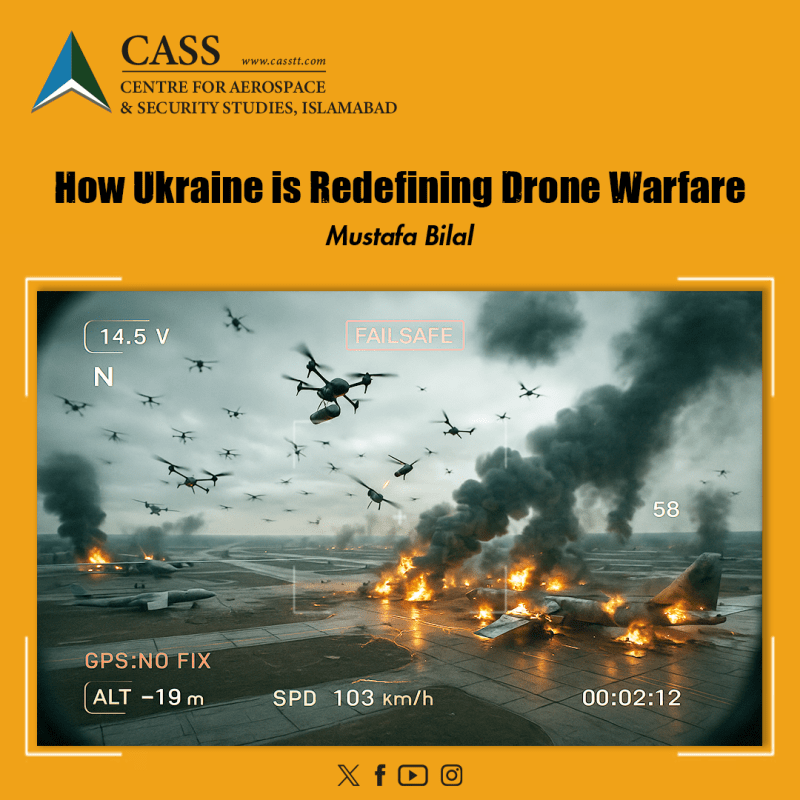
Last month on 1st June, Ukrainian intelligence and drone operatives carried out Operation Spiderweb, a remarkable case study in 21st Century asymmetric warfare by utilising 117 ‘wasp’ quadcopters (each with a payload of approx. 1.6kg) to target five Russian airbases thousands of kilometres from the front line. Reportedly, 12 Russian strategic bombers and two Airborne Warning and Control System (AWACS) were destroyed. The quadcopters were much smaller and fewer in number than the 700 drones launched by Russia on 9th July, the largest drone attack on Ukraine during the war. Operation Spiderweb thus underscored that the quality of employment tactics can achieve better effects on the battlefield than the quantity of drones employed.
This operation was also an exemplar of dominating narrative control. By publicly claiming responsibility for the attack and calling it Russia’s ‘Pearl Harbour’, Ukrainian officials demonstrated a sophisticated understanding of escalation management. Successfully carrying out such a strike without provoking massive retaliation suggests a deep understanding of Russia’s nuclear thresholds, despite its ongoing nuclear sabre-rattling. Notably, Ukraine only targeted strategic bombers, which Russia was employing to massively shell Ukrainian cities with conventional missiles.
Operation Spiderweb did more than destroy Russian bombers. It disrupted an entire system. The sight of scorched airframes was striking, but the real blow was symbolic: small, seemingly innocuous quadcopters, often seen as toys or hobbyist novelties used for photography or racing, had challenged decades-old assumptions about strategic airpower and military sanctuary. Most sources report the price of these quadcopters to be under USD1000 each, yet they have extracted a heavy price from Russia as strategic bombers cost hundreds of millions of dollars. Operation Spiderweb, therefore, highlights that the financial barriers to inflicting strategic damage against far powerful adversaries have been drastically lowered. A sub-USD 1000 quadcopter can now destroy a USD 100 million bomber through stealth, surprise, and saturation by operatives who are adept at concealment, coordination, and creativity.
It is noteworthy that despite being low-cost, the quadcopters were reportedly AI-augmented to identify structural weaknesses in the airframes. AI also likely assisted in flight stabilisation in combination with an old open-source drone autopilot software like ArduPilot. The technical ingenuity demonstrated by Ukraine in executing this operation underscores that militaries that lag in developing AI-human integration platforms will be outpaced and outmatched by those that succeed in doing so.
Perhaps the most concerning characteristic of Operation Spiderweb was ‘stealth logistics’ that weaponised Russian highways used to discreetly transport quadcopters in civilian trucks near airbases. States now face a seemingly intractable security dilemma: the impracticality of inspecting every container, truck, and cargo. The logistical burden of such an undertaking would be entirely unsustainable. Tackling this challenge would require integrating AI and big data analytics into logistical supply chains and ensuring seamless coordination between military, customs, and law enforcement agencies (LEAs). Beyond logistics, the modern battlespace includes the air littoral, a vast, low-altitude, low-cost, and low-signature domain where quadcopters can bypass legacy air defences like the Russian Pantsir and S-300 batteries. Thus, a key takeaway from Operation Spiderweb is that perimeter defence must be transformed from a linear air defence wall into a multidomain shield that incorporates the electromagnetic spectrum.
Drawing on the above discussion, one could say that just like Blitzkrieg redefined speed and shock, and Stuxnet redefined cyber warfare, Operation Spiderweb has redefined drone warfare, weaving a new, unsettling reality and offering a new blueprint for future conflicts. Nearly two weeks after this operation, Israeli intelligence operatives destroyed Iran’s air defences in a similar operation following the same playbook. Hence, states that fail to draw lessons from Operation Spiderweb and adapt with urgency: prioritising layered, cost-effective counter drone defences such as the interceptor drones developed by Ukraine, hardening critical infrastructure resilience, securing vulnerable seams of logistical supply chains, and creatively re-writing the rules of engagement before the adversary does, will find themselves as exposed as Russia’s bombers on the morning of 1st June.
Mustafa Bilal is a Research Assistant at the Centre for Aerospace & Security Studies (CASS), Islamabad. He can be reached at [email protected]