
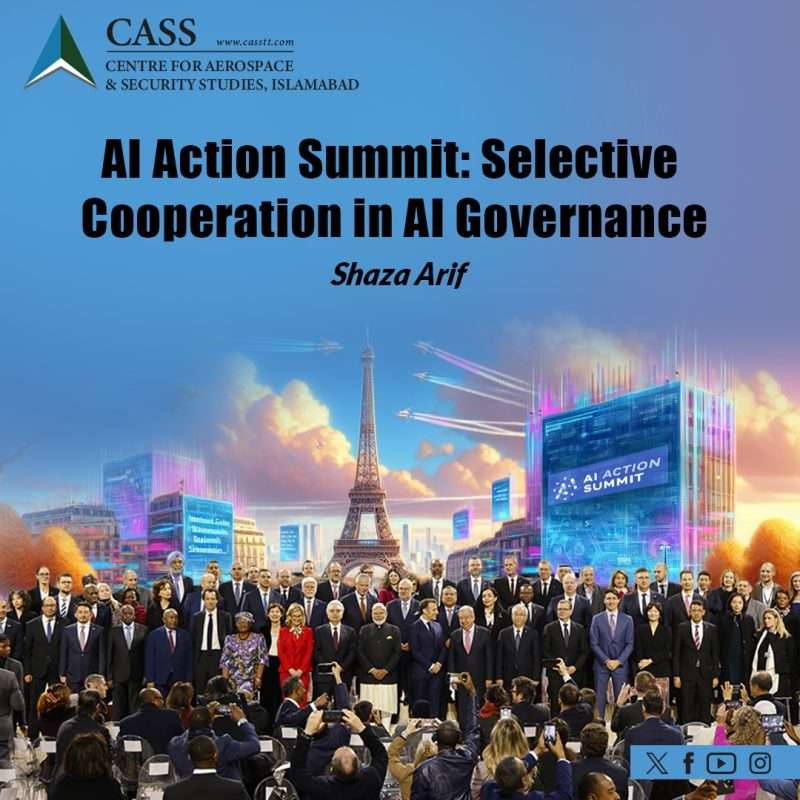
The recent Artificial Intelligence (AI) Action Summit held in Paris has once again underscored the AI-related agendas that have seized the global discourse. Co-hosted by France and India, the summit has stirred renewed hype in the tech community. The summit aimed to increase AI accessibility while ensuring that the use of AI remains transparent, safe, secure and trustworthy. In addition, bridging the global digital divide by promoting sustainable AI and empowering both developed and developing states was also a key objective.
To be fair, the summit concluded on a mixed note. While the event was successful in stirring discussion on a pressing subject globally, the refusal of the United Kingdom (UK) and United States (US) to sign the proposed summit agreement was the highlight of the event. The development comes with notable implications and questions on the future of AI governance. The UK and US have actively advocated for AI safety – in fact, the UK hosted the first Global AI Summit in 2023. The recent event reflects recalibration of priorities, with emerging conflicts of national and multilateral commitments.
While the divergent goals blur the path towards AI regulations, they also highlight the geopolitical struggle over technological dominance. Once dominated by US and Western states, there is a notable shift in the monopoly of cutting-edge technologies with the advent of new states and actors, with China being the most important player in this regard. China’s AI initiatives, which have unfolded recently, have certainly rung alarm bells in its Western counterparts.
The timing of the summit also coincided with the launch of DeepSeek. The Chinese startup has been in the headlines ever since its launch. The astounding reasoning capacity of the model and the relatively lower cost compared to the American models have undoubtedly sent shockwaves across the industry. The immediate impact of the development was imminent, with Nvidia losing nearly USD 600 billion in market capitalisation shortly after. Subsequently, DeepSeek was banned in Taiwan, South Korea, and Australia, primarily for employees in the government sector. Other countries, including the US are also expected to follow suit due to growing security concerns
In the technological realm, China is challenging the Western stronghold in AI-driven industries, a forte of the Western private sector in innovative ways. A recent example in this case is the announcement of BYD offering autopilot features in nearly all of its cars for free. Approximately 21 models, including the Seagull Hatchback, which is priced as low as CNY 69,800 would be equipped with autonomous navigation and self-parking abilities, enabling a new era of intelligent driving with increased accessibility of autonomous driving. Such innovations will likely force Western automobile companies, who have been at the forefront of autonomous driving such as Tesla to rethink their market approach. An added implication is that the reduced cost has also raised optimism regarding states that fall short on financial investment in AI to still make advancements in the frontier via advanced data training techniques. Resultantly, China has shattered the myth of expensive AI, unfolding easier access to the masses. By actively participating in a global forum for AI, China is establishing a strong foothold in AI and its potential governance in future, marking a notable gain on the diplomatic front.
Developments at the AI Action Summit reflect that the optimistic vision of the technology is drawing more attention, taking edge over safety concerns. It is likely that the technological race will only accelerate in future with more states moving towards AI integration. Hence, the global governance of AI is likely to remain fragmented in the near future. The episode has also put the remaining European states at a problematic stop, given that the region had made notable progress in data privacy laws and regulations. The recent developments may ring alarms regarding the future trajectory of the establishment of AI regulations and subsequent adherence to the rules in the region. The concerns are further compounded by the impending advent of Artificial General Intelligence (AGI) and Artificial Super Intelligence (ASI), which will likely add to the existing challenges.
As far as India is concerned, the recent episode highlights India’s growing tech ambitions. By co-chairing the summit with France, India wants to carve out its essential role in future AI governance, putting itself as a major player in emerging technologies. Despite signing multiple agreements under the Initiative on Critical and Emerging Technologies (iCET) with the US, collaboration with France and other European states, the partnership shows a balanced approach vis-a-vis the technological realm – avoiding overreliance in one bloc. This also allows for attracting expertise and investments from different regions. Likewise, such platforms can help India to expand its AI ecosystem via increased collaboration with other global leaders to overcome domestic infrastructure and regulatory gaps. Nevertheless, the UK and US’s cautious approach has been a significant setback for India, limiting the feasibility of unified global governance and impeding progress in this domain.
The global AI landscape is marked by politicisation of technology, the impact of which is likely to be profound in future. The ongoing developments suggest that AI governance is not solely a technological issue; its scope extends to geopolitics, global economy, and society. The global governance of technology will remain dependent on how nations balance national interests and global cooperation. The choices made today will significantly influence generations to come. Lastly, amidst such developments, Pakistan needs to actively follow the ongoing trends, engage with international community and chalk out its role in the technological realm.
Shaza Arif is a Research Associate at the Centre for Aerospace & Security Studies (CASS), Islamabad. The Article was initially published in The News International. She can be reached at [email protected].



