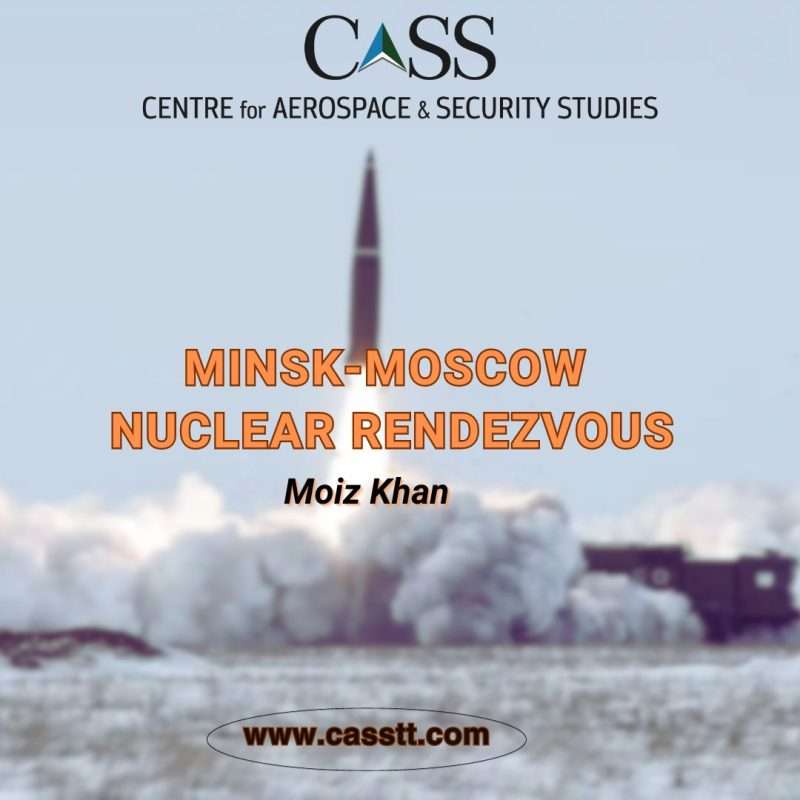
Moscow and Minsk, a supranational union called the Union State, agreed to station tactical nuclear weapons (TNWs) in Belarus on 25 May 2023, a decision in consideration since December 2021. Russia delivered the first batch of weapons in June 2023, with the rest expected to be deployed by year-end. In August 2023, Poland also confirmed the movement of weapons. This marks the first time post-Soviet Union Russia has stationed nuclear weapons beyond borders. Russia and Belarus cited increasing Western threats, sanctions and continued military build-up by NATO countries and the recent arming of Ukraine as the reasons for deployment. Though the Union State claims that this move will strengthen deterrence against the United States (US) and NATO, it undermines nuclear non-proliferation norms. It also raises the risk of escalation in nuclear brinkmanship by Russia amidst its conflict with Ukraine.
Following the Soviet Union’s disintegration, Belarus committed to return the previously inherited nuclear weapons to Russia under the 1990 Declaration of State Sovereignty and the 1992 Lisbon Protocol. Minsk joined the Nuclear Non-proliferation Treaty (NPT) as a non-nuclear weapon state in July 1993. After receiving security assurances from the US, the United Kingdom (UK) and Russia under the 1994 Budapest Declaration, Belarus transferred all nuclear weapons by November 1996.
However, after nearly two decades, Belarus shifted its nuclear policy and decided to host the Russian TNWs. The country had to amend its constitution in February 2022, which now omits reference to its previous ‘nuclear-free status’. Belarus is currently under severe Western sanctions for alleged rigging of its 2020 Presidential Elections and involvement in Russia’s invasion of Ukraine. Therefore, it considers the West’s political and economic pressure a legitimate concern for its national security prompting the need to bolster defence capabilities.
Meanwhile, Moscow’s stationing of TNWs in Belarus aims to ensure the security of the Union State and raise the stakes of its conflict with Ukraine. NATO and the US have criticised Moscow, calling the deployment irrational and destabilising. Ukraine and its Western allies have expressed concerns that TNWs could be used in the battlefield. However, Russian decision is influenced by the UK’s provision of ‘armour-piercing shells containing depleted uranium’ to Ukraine. Moreover, the prolonged Ukraine war and extensive Western support has placed Russia in a situation reminiscent of the Cold War era. During that time, the USSR had to introduce TNWs to counterbalance NATO’s overwhelming conventional forces. NATO membership to Eastern European states, possibility of stationing nuclear weapons in Poland, and ongoing military build-up in Lithuania and Latvia are pushing Russia into a somewhat analogous predicament. Consequently, Russia is responding by stationing TNWs in Minsk.
It is not clear how many weapons Russia will deploy and there will be two delivery systems for the TNWs including Su-25 aircraft and Iskander missiles. Given quantitative and qualitative military superiority of NATO, forward deployment of weapons helps Russia maintain military balance. It elevates the country from a disadvantageous position vis-à-vis NATO. The weapons would be effective against artillery, infantry and airbases and command posts. Though the move deters the alliance, it also involves risks of inadvertent escalation of the Ukraine war. If NATO members become involved directly in the war, there is a possibility that these TNWs might be employed.
Besides risks of escalation, the deployment also goes against non-proliferation norms. For Belarus, hosting TNWs violates the 1990 ‘Declaration of State Sovereignty’ aimed at assuming a non-nuclear weapon state status. The decision also amounts to violation of the ‘Budapest Declaration’, undermining its security guarantees. Interestingly, Belarusian President Alexander Lukashenko is not a popular leader. His decision may further strain his popularity, given public opposition to the constitutional amendment facilitating stationing of the Russian TNWs.
Additionally, the TNWs deployment is in violation of the NPT as Article I and II of the Treaty forbid the state-parties to transfer or receive ‘whatsoever of nuclear weapons or other nuclear explosive devices’ in any ‘direct or indirect’ manner. However, Russia is deflecting criticism from the EU and the US for deploying TNWs in Belarus by arguing that its decision mirrors NATO nuclear sharing arrangement, aligning with US’ deployment of its 100 B-61 nuclear gravity bombs within five NATO countries including Belgium, Netherlands, Italy, Germany and Turkey. Russia asserts it will retain control over the TNWs and their use.
However, it may be noted that NATO nuclear sharing predates the entry into force of the NPT. While nuclear sharing remains a topic of negotiations during NPT review conferences, Russia’s deployment of TNWs abroad is the first instance since NPT’s adoption. It is raising concerns amongst non-nuclear weapons states (NNWS) about the NPT’s effectiveness. Several NNWS have noted that the move undermines the non-proliferation regime and sets a precedent for other countries to host nuclear weapons.
Against this aforementioned backdrop, the international community must create a conducive environment for Confidence Building Measures (CBMs) between Russia, Ukraine and NATO to avoid further escalation. The UNSC and the Organisation for Security and Co-operation in Europe (OSCE) could facilitate a dialogue. Meanwhile, NATO also needs to exercise restraint by not expanding its nuclear capability in the region. To manage the Russia-Ukraine conflict and escalation, the West should seek diplomatic solutions and negotiations, rather than using coercion and armament.
Moiz Khan is a Research Assistant at the Centre for Aerospace & Security Studies (CASS), Islamabad, Pakistan. He can be reached at [email protected]
Design credit: Mysha Dua Salman