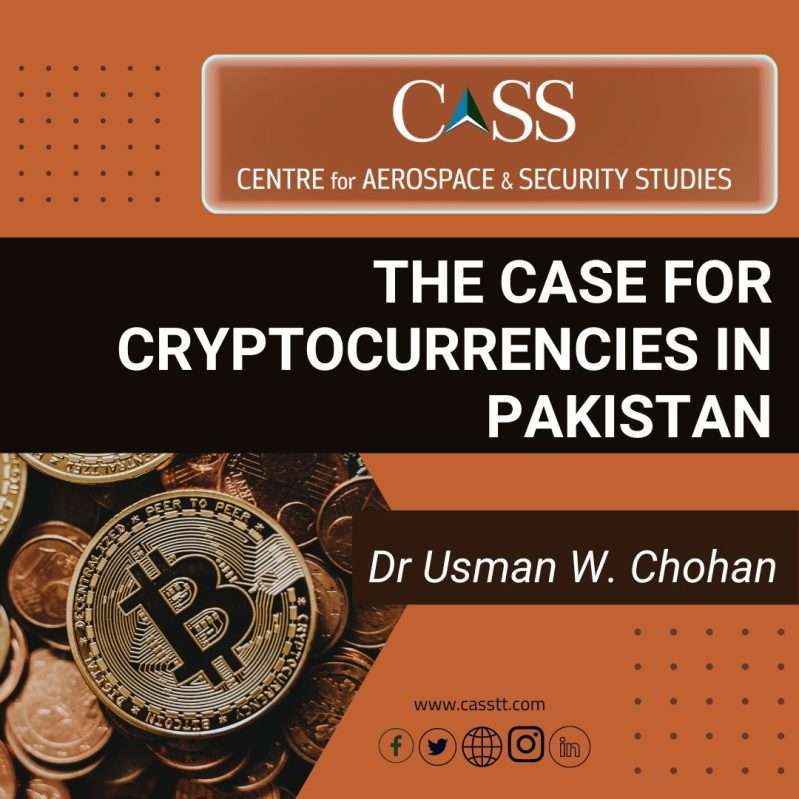
There is a burgeoning conversation in Pakistan around the use and ownership of an asset class commonly known as “cryptocurrencies.” While heightened investor, academic, and regulatory interest in this new form of economic capital is already well-documented around the world, the increasing focus in Pakistan is also a welcome trend. Although Pakistan may be seen as “late” to enter the world of cryptocurrencies, given that several dozen countries now have well entrenched systems for regulating and overseeing cryptocurrencies, the delay in entrance might augur well for the country since it has better international templates to observe.
Over the past few years, many people in the crypto-space generally interpreted Pakistan’s (read: The State Bank’s) attitude towards cryptocurrencies to be hostile, akin to an outright prohibition. However, the SBP has made recent comments about the legality of cryptocurrencies that offer an indication of caution but not prohibition, which leads many to see this curious asset class as something worth considering more closely. There are a great many merits for the usage of crypto-instruments in Pakistan’s local context. As a first point, cryptocurrencies do not move in tandem with other major financial instruments (usually), which means that individuals can construct a low-cost hedge for their wealth.
More specifically, cryptocurrencies such as Bitcoin (BTC) and Ethereum (ETH) are useful stores of wealth for individuals who have savings in the Pak Rupee (PKR), which has a long-term depreciating path. In the past 15 years, the PKR has gone from 55 to the US dollar to now more than 160 to the dollar. The erosion of the rupee mirrors a larger phenomenon in emerging markets of currency depreciation over time, to which cryptocurrencies can offer a hedging instrument due to (1) their acyclical relationship to business cycles, and (2) their deliberately finite supply. For example, Bitcoin can only be mined to 21 million units, but the SBP (and any other central bank) can print as much money as they like, with the penalty of runaway inflation for those countries that are not currency sovereign.
In addition to an affordable hedge against price inflation and currency depreciation, cryptocurrencies are a weightless store of wealth for a society where precious material objects (e.g. gold jewelry) remain a major vulnerability. Cryptocurrencies, by contrast, are mere code, accessible theoretically anywhere. This also helps cryptocurrencies become a sound manner of remitting or transferring wealth without excessive fees and oversight, although the downside of this should be considered as well. Still, the seamless transfer of assets around the world facilitates the movement of capital where otherwise physical or legal controls might persist.
As the base of cryptocurrency users grows, the network itself becomes more stable in terms of lower price volatility. This also inherently increases the value of the underlying asset as a greater number of people accord it with legitimacy. In other words, Pakistanis investing in cryptocurrencies helps to increase the value of cryptocurrencies for other Pakistanis (and citizens abroad). Known to have a creative young population, the people of Pakistan themselves can push the design and utility of cryptocurrencies through innovation; thus becoming contributors to an emergent wealth-technology, rather than merely as users.
In addition, in a society that is mired by unscrupulous wheeling and dealing, and a low level of interpersonal trust outside a kinship group, cryptocurrencies offer a remarkable solution of “trustlessness.” The trustless attribute of cryptocurrencies implies that people are not obligated to forge a trust-relationship, or to know the counterparty, in order to transact. This is due to the underlying structure of blockchain code which offers immutable recordkeeping reinforced through decentralization, freeing people from the need to rely or trust one another before interacting. This is a particularly powerful tool in a society such as ours.
In fact, insofar as the design of cryptocurrencies need not be decentralised to individuals, the SBP can follow the work being done by other central banks in introducing its own state-backed cryptocurrency: a sort of “Crypto-Rupee.” This idea is being proactively pursued by many governments around the world including China, Russia, the EU, and the UAE. Some of the drawbacks of cryptocurrencies are eliminated by central bank oversight of a virtual currency, but this comes at the expense of key benefits offered by the original cryptocurrencies.
Despite all of these merits that build a strong case for Pakistanis to engage in the cryptocurrency universe, there are some very serious caveats that must be addressed before mass adoption is allowed or encouraged. Above all, cryptocurrencies can and do get misused for money laundering and terror financing (AML/CFT), which remains a serious concern in Pakistan, at least if one follows the FATF’s documentation. Even if criminal intent is not in question, cryptocurrencies can still be used to skirt government oversight, evade taxes, and bypass proper remittance channels, which in the larger picture is very bad for Pakistan’s formal economy.
At the same time, the FATF can use the proliferation of cryptocurrencies in Pakistan as a pretext for continued grey-listing, even if the scope of such activities is small. The solution for Pakistan may lie in the imposition that cryptocurrency rules must comply with FATF guidelines for virtual assets and virtual asset service providers (VASPs). These include embedding them within the existing banking system and proper accounting and bookkeeping, along with tough enforcement actions and regular institutional oversight. The FATF has yet to perfect its guidelines, but they are a useful starting point for any country that is to pursue cryptocurrencies in the present financial-regulatory environment.
In sum, while caution must be exercised, and the nefarious possibilities of misusing cryptocurrencies must be recognized, there are still many reasons why a country such as Pakistan may, at least to the restricted degree of formalised financial oversight, engage with the crypto-space. There is much promise in undertaking financial innovation in Pakistan, so long as it is pursued with tough enforcement and benevolent intent.
Dr. Usman Chohan is Director at Centre for Aerospace and Security Studies (CASS). This article was first publsihed in The Nation newspaper. The author can be reached at [email protected].