Today, a ‘global energy transition’ is underway as the world witnesses a shift away from fossil fuels as the major energy sources towards renewables and nuclear power. The transition has been particularly accelerated by the global energy crisis triggered by the war in Ukraine as countries explore strategies to achieve more secure energy systems. According to the analysis in the World Energy Outlook 2022, the global demand for all fossil fuels is already showing a peak or plateau and total demand will reduce from the mid-2020s to 2050 at an annual average almost equal to the lifetime output of a large oil field.
With this comes an opportunity for countries, including Pakistan, that receive a generous supply of Renewable Energy (RE) sources. Scholars suggest that countries that build their capacities to harness these sources can increase their influence and power relative to others, as a thriving RE industry would enable them to reduce external dependence, shield their economies from external shocks that affect global commodity prices, and eventually become its net exporter.
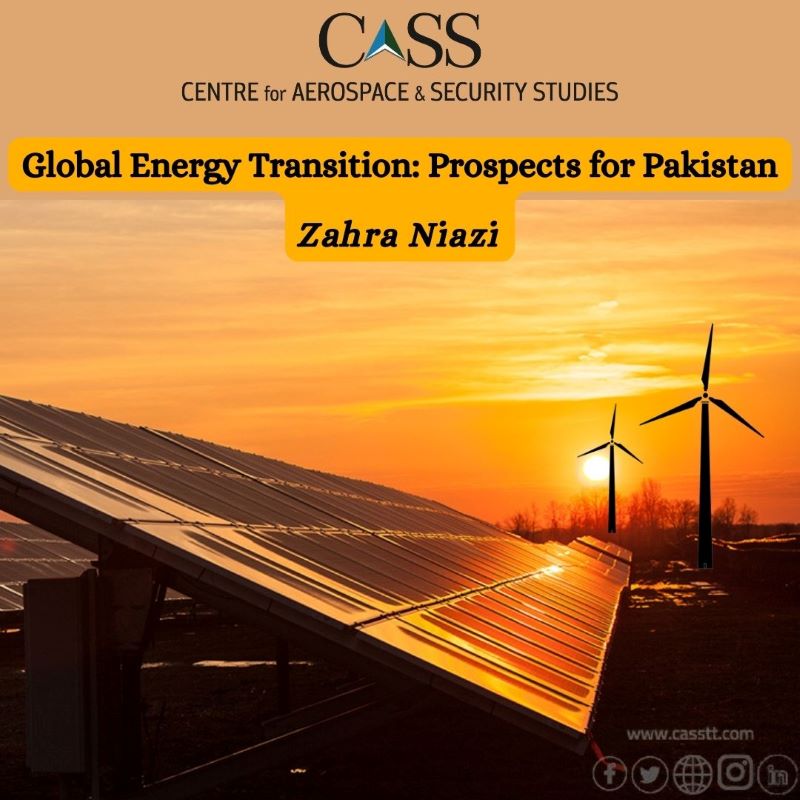
Pakistan is a ‘high-insolation country’ and receives 1 KW of solar energy per square meter of its terrain for an average of 6-7 hours each day. The World Bank has emphasised that Pakistan can fulfil its present electricity demand if just 0.071% of its area is exploited for Solar Photovoltaic (PV) energy generation. It is encouraging to note that solar power is increasingly penetrating the local market, and successive governments in recent times have demonstrated a willingness to exploit the country’s abundant solar potential. To date, six major solar power projects amounting to 430 megawatts (MW) capacity have been completed, four major projects with a capacity of 230 MW are under construction, and many more are in the pipeline. The year-on-year data for power generation also indicate a steady increase in solar energy use in Pakistan’s total energy mix over time.
Notwithstanding this, the contribution of solar is still meagre compared to the potential, as in the first ten months of FY2023, Pakistan only produced 0.8% of its electricity through solar. The country’s target in the Indicative Generation Capacity Expansion Plan (IGCEP) 2022-31 of producing around 60% of its electricity through clean energy by 2031 also predominantly relies on hydropower and sets the target for solar at 10%. The question remains as to how we can accelerate the deployment of solar in the energy sector and develop a thriving solar power industry.
Experts emphasise that the beneficiaries of the current ‘global energy transition’ will be countries with the ability to combine the natural abundance of specific RE sources with technology. Currently, Pakistan is one of the largest importers of solar technologies, which has hindered the widespread adoption of solar energy in the country. However, on a positive note, Pakistan possesses two major opportunities to drive the growth of the indigenous solar technology industry.
First, clean energy technologies are mineral-intensive, with copper and aluminium being the two most important minerals for solar technologies. Pakistan is sufficiently endowed with precious deposits of copper. Copper is already being mined in Shinkai in North Waziristan and Saindak in Balochistan, while Reko Diq in Balochistan has one of the world’s largest copper-gold deposits that are set to be exploited in the coming years. Likewise, Pakistan possesses considerable reserves of the principal ore of aluminium, i.e., Bauxite, particularly in the Khushab district of Pakistan.
Second, the country’s immediate neighbour and all-weather friend, China, has made a substantial investment in solar PV plants in Pakistan. It also currently dominates the industry for manufacturing clean energy technologies and their components, possessing more than 60% of the global manufacturing capacity. Pakistan’s collaboration with Chinese companies in this domain can offer enormous benefits, including the opportunity to acquire experiences, expertise, resources, such as facilities and infrastructure, and knowledge. The Chinese have already expressed a desire to collaborate with Pakistan’s solar energy companies. Haining City has become an important hub for photovoltaic energy storage and other RE enterprises. The Deputy Director of the Economic Development Office of Zhouwangmiao, Haining City, has recently encouraged Pakistani solar energy companies to collaborate with relevant Chinese companies.
Immediate and vigorous steps must be taken to exploit these opportunities fully. A policy for promoting indigenous development of solar panels and allied equipment is currently in its final stages of approval. In addition, An enabling ‘Solar Technology Action Plan/Framework’ must also be formulated that analyses all key barriers to local manufacturing and mass replication of solar technologies and proposes detailed actions to mitigate those barriers. The proposals should put considerable focus on accelerating collaboration with key countries, including China, further developing the country’s mineral sector for these technologies, mobilising private investment, and investing in Research and Development (R&D).
With the right vision, stronger political commitment, and systematic planning, Pakistan can bring a transformational shift in its energy outlook and successfully establish its mark among the world’s leading solar power-producing countries.
Zahra Niazi is a Research Assistant at the Centre for Aerospace & Security Studies (CASS), Islamabad, Pakistan. She can be reached at [email protected].