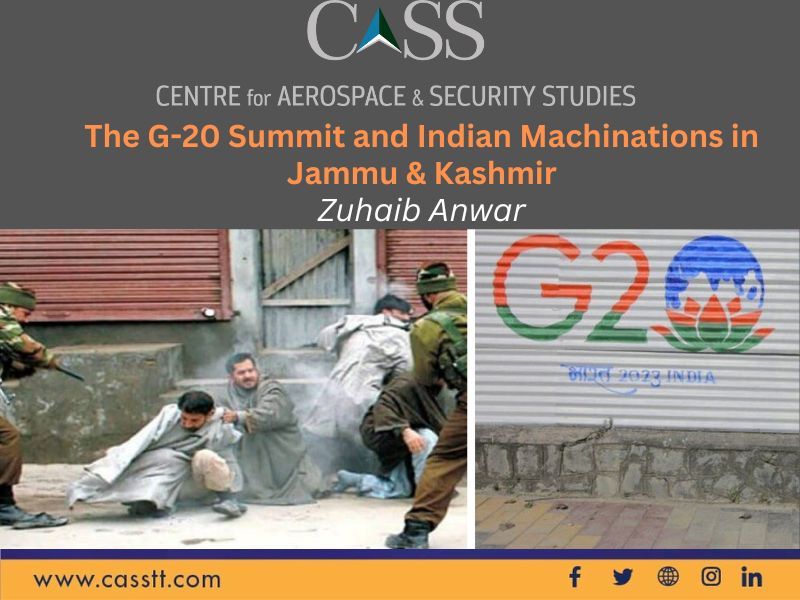
In December 2022, India took over presidency of the Group of 20 (G-20) – an intergovernmental economic cooperation forum comprising 19 countries and the European Union (EU). This year India is expected to host around 215 G-20 meetings at around 55 different locations around the country. It organised one meeting in the capital of Arunachal Pradesh – a disputed territory between India and China in March this year. China boycotted the meeting. Apart from other locations, New Delhi plans to hold the G-20 Tourism Working Group and the Youth 20 meetings in Srinagar and Leh areas of Indian Illegally Occupied Jammu and Kashmir (IIOJ&K).
Pakistan has objected to the Indian decision and accused New Delhi of exploiting its membership of an important international group for advancing its self-serving agenda, by holding forthcoming G-20 meetings in a disputed region. Similarly, Pakistan has also asked friendly countries like China, Saudi Arabia and Turkey, that are part of G-20, to boycott the meetings being held in the disputed territory.
The spokesman of the Indian External Affairs Ministry, while reacting to Pakistan’s objection said that it was natural to hold the meetings in two Union territories of India, and added that the G-20 meetings were being held across the country and since it has always considered the region an ‘integral and inalienable part of India’, therefore, it was natural to organise meetings in the region.
Since Prime Minister Modi came to power, his government has been making attempts to solidify the illegal Indian claim over Jammu and Kashmir (J&K) that have included abrogation of Article 370 of the Indian constitution that grants special status to J&K and splitting it into two Union territories of Jammu and Kashmir and Ladakh. India has also been trying to make demographic changes in the region by encouraging Hindus to settle in the area, granting domicile certificates to non-locals and giving them citizenship rights.
This Indian move to hold G-20 meetings in IIOJ&K is neither a random decision nor is ‘natural’, rather it is a calculated move by the Indian government to get international legitimacy for its illegal acts of abrogation of Article 370, splitting the region into two territories and getting it recognised by the international community as a part of India. Diplomats and delegations will be travelling to IIOJ&K, upon obtaining Indian visa and media around the world will report from the region describing it as ‘Indian Territory’. This will be a projection of IIOJ&K as a de facto part of India, and will help New Delhi build an international narrative that the disputed area is part of the country.
Despite Pakistan’s objections and calls for boycott, the state has not been successful in countering India’s move. Regrettably, the government and opposition parties are engaged in a domestic power struggle, causing a lack of interest in regional affairs. It is crucial for Pakistan’s national interest that the government takes necessary steps to counter Indian propaganda. Some measures that can be implemented at this stage include the following:
Firstly, Pakistan’s missions abroad particularly in P5, the Middle East and other important countries should be activated to raise this issue citing violations of UNSC resolutions. Secondly, an effective media strategy may be devised to propagate Pakistan’s principled stance on the Jammu and Kashmir dispute. This can be done by arranging interviews of high-level government officials like the President of Pakistan, Prime Minister or the Foreign Minister with the international media. Apart from this, there is a practice that heads of state or ministers write opinion articles in internationally recognised media platforms to highlight their stance on a particular issue. Several Pakistani Prime Ministers and Presidents have done so in the past – this can be done again. Lastly, the issue should be raised at the United Nations reminding the world that Jammu & Kashmir is a disputed territory, illegally occupied by India that requires resolution according to the UNSC resolutions.
Pakistan must actively make its case and dispel the Indian notion of projecting IIOJ&K as part of its borders. If Pakistan fails to do so, India will use these events to show the world that Jammu & Kashmir is its integral part, further weakening our stance on this dispute.
The author is a Research Assistant at the Centre for Aerospace & Security Studies (CASS), Islamabad, Pakistan. He can be reached at [email protected]
Image Design: Mysha Dua Salman