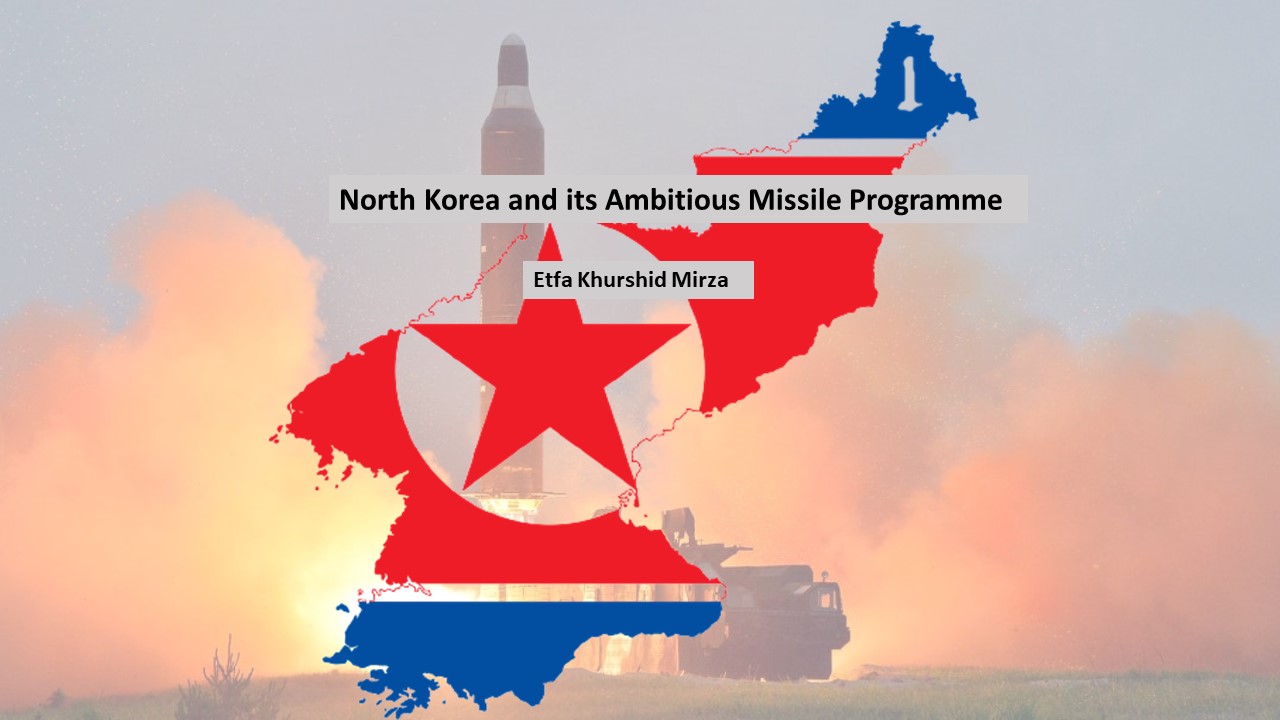
During the past few months, there have been several significant strategic developments in the Korean Peninsula where North Korea is conducting back-to-back missile tests. January 2022 has been a record-breaking month for the country as it carried out seven different missile tests of both short and medium range missiles, from ballistic to cruise and supersonic to hypersonic missiles. Despite economic sanctions and opposition from the United States and its allies, North Korea has been modernising its military.
Due to its advancements in missile technology, the North Korean nuclear programme has also been an eyesore for the proponents of non-proliferation. It has been under criticism since the country withdrew from the Non-Proliferation Treaty (NPT) in 2003 and carried out nuclear weapons tests in 2006 and 2009. Withdrawal from the NPT and subsequent nuclear tests pose significant challenges to the non-proliferation regime, such as the Treaty’s effectiveness in terms of rules governing withdrawal and the role of international community to necessitate compliance with its terms and conditions.
If we look at the brief chronology of missile testing in the past before moving on to the current situation, North Korea in 2012, successfully launched a satellite, a technology that can be used in ballistic missiles as well. Subsequently, a series of tests were carried out including short and medium range missiles until 2017 when the country tested its first intermediate range ballistic missile Pukguksong-2 with a range of 500 kilometers. This was followed by similar tests (Hwasong-12, 14 and 15) with higher ranges (4500 km, 10400 and 13000, respectively) in subsequent years. North Korea claimed that these missiles were capable of reaching the United States as well. During 2019 and 2020, the DPRK conducted large caliber Multiple Rocket Launch System (MRLS) tests bringing it closer to reliable deployment status.
With ballistic missiles, Pyongyang also tested a long range cruise missile (1500 km) on 12-13 September 2021 that was reportedly a first of its kind missile having strategic significance. Soon after, given the hype about hypersonic weapons, Pyongyang tested Hwasong-8 ballistic missile with a detached hypersonic glide vehicle on 28th September. According to its state media, hypersonic weapons development is ‘one of top five priority tasks facing the strategic weapons sector.’ More recently, in January 2022, North Korea again claimed to have tested a hypersonic ballistic missile. They conducted two such tests and cumulatively seven in January 2022. This is a huge leap forward in the country’s military modernisation.
This military modernisation and advancements in missile technology is alarming not only for the US, but for neighbouring countries Japan and South Korea as well. After the missile tests in Jaunary-2022, the US proposed a UNSC meeting to discuss the current situation and advocated to impose tougher economic and financial sanctions on North Korea. However, China, Russia and some other countries opposed the US idea. Rather, China’s Ambassador to the UN urged the US to exhibit flexible behaviour towards North Korea.
Since North Korea’s withdrawal from the NPT and subsequent tests of its nuclear weapons, United Nations Security Council (UNSC) adopted nearly a dozen resolutions imposing sanctions on Pyongyang and regularly monitors their implementation through the North Korea Committee and panel of experts. The UNSC regularly produces reports on sanctions status and their enforcement. According to a recent confidential report to the said committee, North Korea continues to develop and maintain its nuclear and ballistic missile programme despite the sanctions. The prime source of funding for its nuclear and missile programme has been cyberattacks on cryptocurrency firms and exchanges. This report also points out that ‘cyber-actors stole more than $50 million between 2020 and mid-2021 from at least three cryptocurrency exchanges in North America, Europe and Asia, probably reflecting a shift to diversify its cybercrime operations.’
Considering the evolving situation in the Korean Peninsula, where North Korea is committed to advancing its missile technology and further strengthening its hard power reflects that in times to come, this region is going to become more significant in the global arena. The roles of two global players – Russia and particularly China – are especially very important and telling regarding the recent developments in North Korea. Both countries withheld their support for harsh sanctions when proposed by the US in the UNSC.
While the US and its allies find the situation destabilising, weapons development by North Korea may be in China’s favour in the short term as they are targeted towards the US and challenging its hegemony in the region. However, this may not be the case in the long-term. When rapidly rising Beijing becomes a global power in the years to come, what will be Pyongyang’s role in its newly formed global order? This is an important question. Will the DPRK be an ally in the region or remain a rogue state that does not fit into China’s security designs?
Etfa Khurshid Mirza is a Researcher at Centre for Aerospace & Security Studies (CASS), Islamabad, Pakistan. Her area of interest is warfare and emerging technologies. She can be reached at [email protected]
Image Source: Etfa Khurshid Mirza