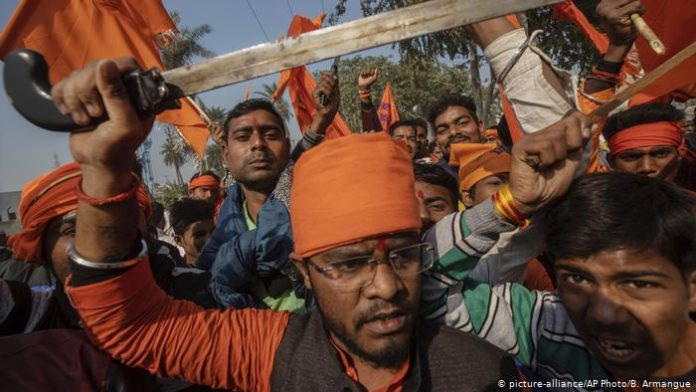
Hate crimes in India against minorities, especially Muslims, are becoming rampant. Day in and day out, there are reports of people being lynched because they are not Hindus or because they belowng to a scheduled caste. Genocide Watch, a global watchdog for crimes against humanity, has recently predicted an existential threat of Muslim genocide in India. Since the Gujarat Massacre of 2002, this organisation has been consistently highlighting this threat. At a recent virtual Congressional Briefing organised by the Indian American Muslims Council on the topic, ‘Hindu Extremist Call for Genocide of Muslims’, Dr Gregory Stanton, head of the Genocide Watch, again highlighted this issue.
He emphasised that revocation of Indian Illegally Occupied Jammu & Kashmir (IIOJK)’s special autonomy and the Citizens Amendment Act (CAA) are systematic state tactics to transform Muslims into statistical minorities in their majority areas. The move is also intended to deprive Muslims of their basic citizenship rights and from their Indian citizenship altogether. According to Dr Stanton, India under Prime Minister Modi was following the ‘Myanmar Model’, where Rohingya Muslims were legally declared non-citizens and then forcibly evicted from their lands through state-sponsored violence and organised genocide. Prime Minister Modi, through acts like the CAA and National Register of Citizenship (NRC) is legally defining Muslim inhabitants of India as ‘aliens’ and employing direct/indirect violent measures to make it impossible for them to live freely in the country.
Both, the Central and state governments, on different occasions, have adopted various laws that target Indian minority communities. Three states – Uttar Pradesh, Himachal Pradesh and Madhya Pradesh – have already enacted anti-conversion laws while many others are in the process of adopting such laws where religious conversion for the purpose of marriage etc. is being outlawed; associating inter-communal marriages with the metaphor of ‘Love Jihad’. ‘Love Jihad’ is a term concocted by Hindu extremists to blame Indian Muslims for allegedly attempting to change the country’s demography by marrying Hindu girls through religious conversions.
The adopted law states that inter-communal marriages without prior approval of the state government would be declared null and void, and those found guilty will be punished through criminal proceedings. In a similar stance, the Central Government led by ultra-nationalist BJP and 19 out of the 30 state governments (mostly ruled by the BJP) have imposed a ban on cow slaughter. They have declared it a cognizable, non-bailable offence where the accused bears the burden of proof, which is in stark violation of the universal human right to be presumed innocent until proven guilty.
Those found guilty would face a maximum jail term of 14 years and up to INR 5 lakh fine or both. Apart from state efforts to curtail the specific socio-religio-cultural ways of life of minorities, many Indian individuals (mostly Muslims), have been killed by vigilante mobs on allegations of cow slaughter, beef consumption or even suspected beef transportation.
Most recently, ‘hijab’ (Muslim veil worn by females) was banned at schools in Karnataka in the name of bringing uniformity and discipline among the students. However, at the same time, the law allowed Hindu students to wear their saffron scarves inside school premises, again highlighting anti-Muslim prejudice. This ban also indicates a systematic state effort (in line with certain Western efforts) to alienate Indian Muslim youth from their religious traditions and also makes it difficult for them to live according to their personal preferences.
The Modi-led BJP government has kept a blind eye to such prejudiced laws, human rights violations, hate speeches and crimes. At ‘Dharma Sansad‘, (Religious Parliament) – a three-day conference held in Haridwar between 17th and 19th December 2021 – right-wing activists, religious extremists, militant nationalists and Hindutva organisations gathered to preach their extremist ideology of hatred. They encouraged hate and violence against minorities and incited the attendees to cleanse India of Non-Hindus. The event was also attended by ruling party leaders, including Ashwini Vpadhpay who was previously arrested for organising a similar anti-Muslim event.
Attendance of such events by ruling party leaders reaffirms that BJP is following the idea of turning India into a Hindu Rashtra (state). Throughout this conference, almost all speakers instigated the audience against Muslims; however, the most stunning remarks were made by Pooja Shakun Pandey – General Secretary of Hindu Mahasabha – who gave Hindus a call to arms to conduct organised genocide. She said, ‘If 100 of us are ready to kill two million of them, then we will win and make India a Hindu nation’. By ‘them’, she was referring to India’s Muslim population. Prime Minister Modi and his senior government officials, being patrons of this ideology, remained silent as always. Initially, administrative authorities also remained indifferent, but after growing global criticism, the offenders were apprehended. There, however, is little evidence of any concrete action being taken under the law for such serious crimes.
Violence and hate speech against Muslims in India have been a historical phenomenon but it has increased many folds since Narendra Modi came to power in 2014. In a ten-year study from 2009 to 2019, more than 90% of hate crimes against minorities were found to have occurred after 2014. India’s Prime Minister, on numerous occasions, has claimed that action should be taken against those committing violence in the name of religion. However, his government has failed to act against such elements. Inaction and tacit complicity of the Modi government have emboldened Hindu supremacists, inspired by Hindutva ideology, to carry out violent activities against minorities. Prejudice against minorities by the government have infiltrated state institutions such as courts, police, and other government offices, enticing Hindu nationalist groups to threaten, harass, and attack religious minorities, especially Muslims, with impunity.
The ultra-right-wing political parties and nationalists, led by the BJP, use hate speech to demonise minorities and encourage discrimination against them for narrow political gains. This callousness frequently leads to violence against targeted populations while seriously eroding the socio-cultural foundations of the once secular Indian society. The international community, particularly the United Nations and other champions of human rights must take cognisance of the growing atrocities against minorities in India and adopt concrete steps/actions to redress the growing threats being faced byall minorities, especially Muslims, living under a persistently threatening Hindu extremist environment.
Zuhaib Anwar is a researcher at the Centre for Aerospace & Security Studies (CASS), Islamabad, Pakistan. The article was first published in Global Village Space. He can be reached at [email protected]
Image Source:Associated Press of Pakistan. 2021. “In Modi’s India, minorities face existential threat amidst rise of saffron terror” Associated Press of Pakistan, October 25. https://www.app.com.pk/national/in-modis-india-minorities-face-existential-threat-amidst-rise-of-saffron-terror/